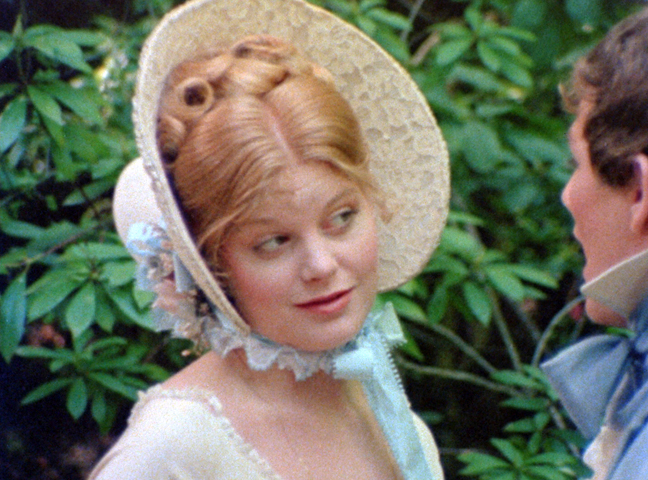
Previously on ‘The Mitchell Brothers – Band of Brothers: The Story of How Two Bearded-Free-Love-Hippie-Filmmakers-turned-Businessmen Changed the Course of Film History, and America Too’:
Artie and Jim Mitchell, settle in San Francisco where they open the O’Farrell Theater in July 1969, and turn it into one of the most famous adult-entertainment strip clubs in the United States, described by Hunter S. Thompson as “The Carnegie Hall of public sex in America”. They produce one of the most profitable films of all time, the X-rated ‘Behind the Green Door’ (1972). And they become known as fearless champions of free speech whose idea of a ‘business trip’ is being carted off to jail after yet another arrest.
Forget Warner Brothers, or even the frères Lumière, the Mitchell Brothers were the most exciting siblings in film.
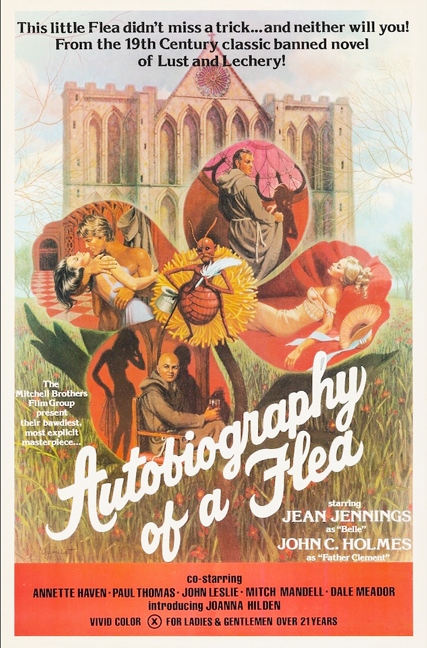
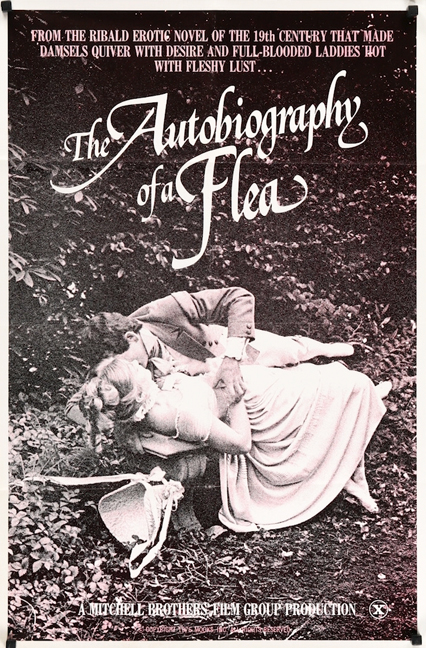
On this episode: when their follow-up movies fail to achieve the same success as ‘Green Door’, the brothers need a hit, so they start working on their next opus, a period drama, ‘The Autobiography of a Flea.’
This is the story of the making of that film.
This essay was part of the extensive extras included in the recent Melusine double feature release, ‘The Autobiography of a Flea’ and ‘C.B. Mamas’, which presented restored versions of both films as well as never before seen outtakes and trim. Buy your copy here.
*
Ahh, ‘The Autobiography of a Flea.’
No – wait, come back: not the memoirs of the Red Hot Chili Peppers’ bassist. This is much more interesting: gather round.
This story starts back in the ’60s.
The 1860s, that is. Not the 1960s with its hippies, tie-dye, and tales of sexual liberation.
And the location is 53 Greek Street.
London, England, that is. Soho. W1D 3DR, to be precise. Not San Francisco, Sin City, and official Smut Capital of America.
In fact, I’m sitting in the actual room on Greek Street where it all began. Nowadays it’s an intimate bar called Thirst, “a chilled space with an awesome range of gins served in huge goblets,” or so boasts its website. Hard to believe that back in the days of Dickens, Darwin, and Joseph ‘Elephant Man’ Merrick, this poky room was the epicenter for an empire of erotica.
In 1869, this location belonged to a local shopkeeper, Edward Avery, who used it to run a non-descript bargain book company. He specialized in purchasing unsold, overstocked, and returned volumes from publishers at a steep discount – which he then resold to consumers. So far, so ho-hum. Except that this anonymous remainders business was actually a front for a more licentious and lucrative trade in pornography – an altogether more illegal venture.
Throughout history, those who decide to flout the law typically fall into one of two categories: either they are political revolutionaries, intent on forcing legal and societal change through their anti-social acts (such as, say, the Mitchell brothers in San Francisco many years in the future: hold that thought, more on them later), or they are money-hungry mercenaries, willing to take personal risks in return for rich rewards (also the Mitchell brothers: hold that thought, too.) Edward Avery fell into the latter category, perhaps because he was smart enough to recognize his all-too-limited individual power in changing the attitudes of a country which wouldn’t, say, publish the unexpurgated edition of D.H. Lawrence’s ‘Lady Chatterley’s Lover’ until 1960 – almost another century later.
By his mid 20s, Avery had put together an extensive and secret grouping of late Victorian publishers, distribution routes, and safe houses that he used to produce and distribute pornographic texts throughout London and to European cities like Paris. (Think of this secret grid like the Underground Railroad, the clandestine, 19th-century network of secret routes and safe houses used by enslaved African Americans to escape to free states in America. Except without the social good. Or the human rights. Or, in fact, the abolition of slavery. So actually, not at all similar, really.)
This network was known as ‘Avery’s Gang’ and the operation was responsible for the proliferation of many notable underground publications, such as ‘The Whippingham Papers’ (a Victorian work extolling the pleasures of flagellation) and a pirated edition of ‘Kama Sutra’ by Sir Richard Burton (no, not that one.) To avoid prosecution, most of the books were printed privately, without publishers’ names, and circulated covertly. As a result, these tomes were expensive – which had the added benefit of keeping the material in the hands of wealthy, educated, and upper-middle-class gentlemen. Collectors, bibliophiles, and intellectuals. You know: upstanding pillars of the community who could actually be trusted to consume such incendiary material without the risk of turning into beastly savages.
Men like Stanislas de Rhodes, for example.
Stan-Rhod, as he almost certainly wasn’t portmanteau-ed back in the day, was a London lawyer intimately familiar with Avery’s black-market publications. Little is known about him, other than he was rumored to have been a member of one of London’s secretive dining groups, progenitors of the Cannibal Club. These were taboo-flaunting gatherings that provided private spaces for radicals to discuss subjects deemed deviant by Victorian society, such as race, science, religion, and sex. These societies were also common channels to share prohibited, scandalous, and forbidden literature.
In 1886, De Rhodes approached Avery with an erotic manuscript that he claimed to have authored. The text was narrated by a flea, and told the story of Bella, a pretty young girl, whose burgeoning sexuality is taken advantage of by her lover Charlie. And then the local priest. And then two of his colleagues in holy orders. Thus corrupted, she turns procurer, giving her friend, Julia, to her father and the priests for their sexual enjoyment.
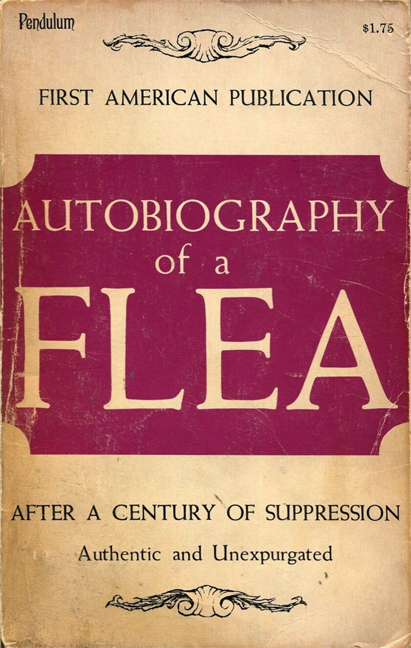
Avery liked it, and the following year, ‘The Autobiography of a Flea, Told in a Hop, Skip and Jump, and…’ was published in a small edition of just 150 copies. To provide some much-needed respectability, the title page of the first edition claimed that it was “Published by Authority of the Phlebomotical Society, Cytheria” in 1789. Balderdash and poppycock, of course, but who cared?
The book in its limited initial run was ignored outside of the opulent bedrooms of its readership. It was reprinted, and a few years later, one commentator deigned to review it, describing it as “a potboiler,” “a work of low quality whose mere creation points to a desperate need by the author to cover his daily expenses.” But the book stayed in print, and its longevity defied the reviews, eventually being considered a cornerstone of the 19th-century underground publishing scene due to its blend of satire and pornography, not to mention its unique perspective into Victorian life.
According to legend, the book has never been out of print in the 140 years since. Not bad for a publication that pre-dated the first Sherlock Holmes story. It’s just a shame that Stan-Rhod didn’t cut a royalty deal for this potboiler.
*
This story now continues in the ’60s.
The 1960s, that is. Not the 1860s with its rapid industrialization, expansion of railroads, and technological advancements like the telegraph.
And the location we now consider is 895 O’Farrell Street.
San Francisco, that is. The Mitchell Brothers’ O’Farrell Theatre in the Tenderloin. CA 94109, to be precise.
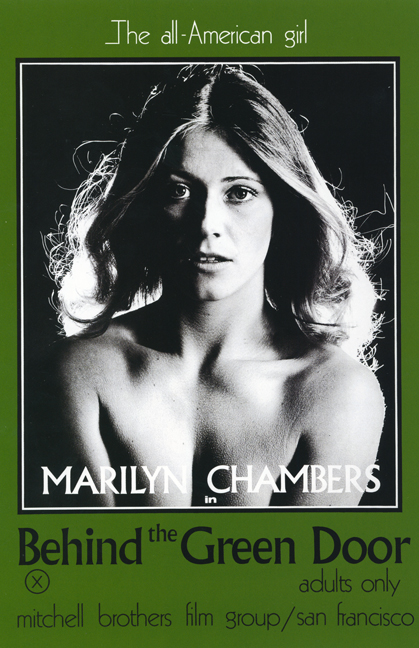
The brothers were familiar with erotic texts like a prisoner is familiar with a file: in 1972 they’d taken an anonymous, 11-page, ribbon copy typescript – long-distributed in underground circles via dog-eared carbon copies – and turned it into Behind the Green Door, a smash hit of the Porno Chic film era. It had earned them notoriety, inflated bank balances, and a immodest hunger to do it all again.
They applied the ‘Green Door’ template to the ultimate historical work of erotic literature: The Bible. Or Sodom and Gomorrah: The Last Seven Days (1975), as it was titled after a judge proclaimed that the Mitchell Brothers’ films “would have been considered obscene even by the community standards of Sodom and Gomorrah.” For that film, the brothers went big, spending a reported $750,000 compared to the $60,000 they’d spent on ‘Green Door.’ It was a legendarily tormented experience, and perhaps unsurprisingly, their attempt to make a biblical hardcore film with a subplot involving aliens whose leader is a chimpanzee who speaks with the voice of John Wayne, flopped badly.
Undeterred, the brothers picked up a copy of ‘The Autobiography of a Flea,’ and a new film project was born.
*
Sharon McNight is a tootsie. She’s a dame. A sassy, independent broad for whom the terms ‘doll’ and ‘moxie’ were invented. The spirit of Mae West wrapped up in a Bette Davis package with an injection of Dorothy Parker.
No doubt, when she was good, she was very, very good, and when she was bad, she was better – but back in early 1975, Sharon was just tired of feeling tired. She was 28 knocking on 40, no longer the next big thing in any shape or form, but still too young to accept the failure of her dreams. Confronted by the only dependable law of life – everything is always worse than you thought it was going to be – she was facing up to some tough decisions.
Let’s rewind for a moment. Raised in Modesto, she’d studied drama at San Francisco State where she chose children’s theater as her specialty. She wrote and directed a number of shows for the children’s division of the Marin Shakespeare Festival, including ‘Wizard of Oz’ and ‘Hansel and Gretel.’ (I know: I’d forgotten those were Shakespeare plays as well.) But after teaching drama at San Francisco City College for a few years and staging a production of ‘Jesus Christ, Superstar’ at the Old First Presbyterian Church, she’d had enough of treading the boards and started dreading the bard.
“After eight years of writing and directing children’s plays – designing and making costumes, building sets, the whole thing – with only 11 days’ vacation, I got tired,” she said. “And I was tired of being a director. Being a woman, it’s really tough to be a director.”
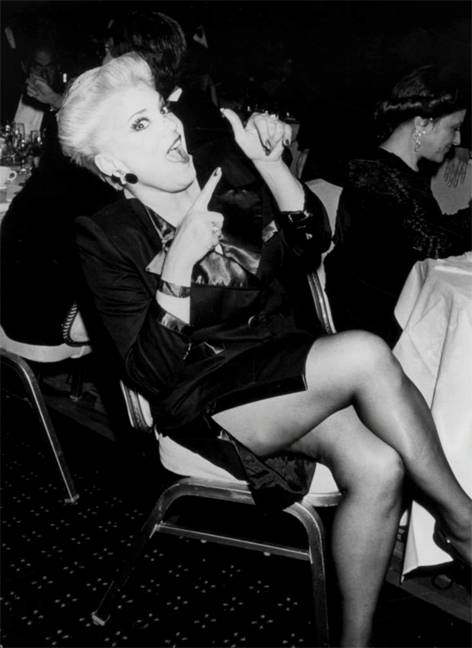 Sharon
So she reverted to Plan B, which actually was Plan A. Her lifelong dream had always really been to be a singer, a chanteuse of cabaret, jazz, and torch numbers. An interpreter of any song that would benefit from a feisty, fire-eating performance. For a time, she fronted a rock blues group called Menage, working her way around San Francisco – from the dark, louche (gay) bars to the bright (gay) night clubs and all the colorful (gay) joints in between – until she realized the inevitable had collided with the unfortunate: she may have been doing what she always wanted to do, but she was still flat broke.
In February 1975, she swallowed her pride and accepted she’d hit rock-bottom: she answered an ad for an accountant position.
Humdrum, she figured. More like helter-skelter, it turned out.
The job was with the Mitchell Brothers Film Group – MBFG to you and me, just like MGM or RKO – the country’s preeminent producer of pornographic movies: “They didn’t tell me what they did straight away. They just warned me there might be offensive language. I mocked them and laughed, and said ‘Oh, golly gee!’ And then, fuck me, I discovered the truth.”
She was offered $50 a week – way more than she’d earned before – but just as persuasive as the pay packet was the dress code: “Jim told me I wouldn’t have to wear nylons and a dress to go to the office,” Sharon remembered, “which was good because I didn’t have any. My wardrobe consisted of director’s clothes – which was Levi’s and t-shirts – and night club attire which was all gowns. There was no middle ground in my closet.”
Sharon got to work and spent three days wrestling with the financial ledgers before the brothers discovered her thespian credentials: an accomplished, well-qualified, real-life actor/director was in their midst. Change of plan: she was put to work as a production secretary, script girl, dialogue coach, costume locator, property guru, and anything else that came up. She worked on ‘Sodom and Gomorrah’ (“for a first film experience that was a baptism of fire like no one in history has ever experienced,” Sharon told the newspapers later) and Artie’s stop-gap project C.B. Mamas (1976) that cashed in on the short-lived craze for Citizens Band radio. And in June 1976, she helped organize a 7½ hour show to commemorate America’s Bicentennial. In true Mitchell Brothers fashion, it was subtitled, ‘A Tribute to Eroticore,’ and featured presentations of MBFG feature films: ‘Behind the Green Door,’ ‘Resurrection of Eve,’ ‘Sodom and Gomorrah,’ ‘The Marilyn Chambers Story,’ and ‘CB Mamas.’ All seats for this extravaganza cost, appropriately enough, $76c.
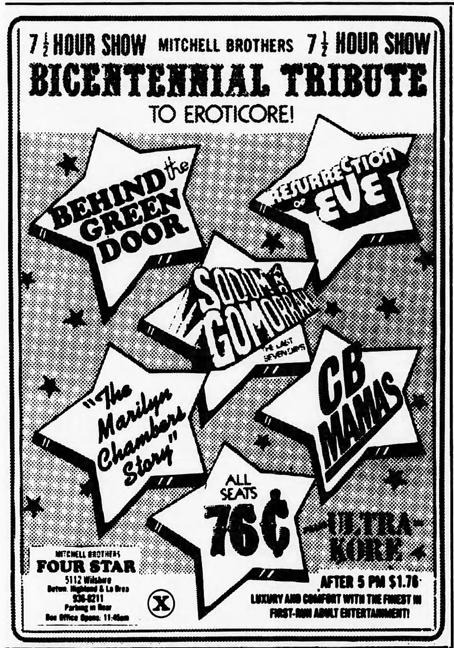
Sharon also had a brief, personal relationship with Jim. It was serious for a hot moment and according to close friends, could even have resulted in marriage had it not been for the unfortunate combination of Sharon’s hysterectomy and Jim’s desire to have kids. They parted amicably with Sharon remaining one of his trusted confidantes for many years after. (In true Mitchell Brothers style, Artie wasn’t left out of their entanglement: he became lifelong best friends with Sharon’s hysterectomist.)
Then one day, Jim walked into the office, threw Sharon a paperback copy of ‘Flea,’ and challenged her to turn it into a script for a hardcore movie. “Make it classy, make it sweet, but make it hot,” were his only instructions, before adding, “I’m going to direct this one, we’re gonna spend six figures on it, and I want it to be good.”
Sharon hadn’t ever seen a porno before she worked for the Mitchells, but now she was writing one. Sure, she’d now seen a few fuck flicks at the O’Farrell, but they hadn’t filled her with confidence – or even lust. “Most erotic movies are such garbage,” she said at the time. “They’re so male-oriented, and they do nothing for the female viewer.”
Sharon started by writing the dialogue: “I brought some subtle changes to the story that make it different from the usual porno film. For one thing, the woman was less of a victim in this than she usually is. Sure, there were also themes of avarice and luxury and all that stuff, but there were also moments of tenderness which I had to fight for. And there was very little violence – and even though the story contained rape scenes, I tried to modify them within the confines of the script.”
Jim was impressed by her draft and started to mobilize the gang for another film production. After the summer of ‘Sodom’, and the treachery and tantrums in the desert when it appeared that God was personally taking retribution for their blasphemous vision, the mood was harmonious in comparison.
But then the team learned that the MBFG was being indicted in a Los Angeles court. Court proceedings were as common as a stray sock in the laundry for the brothers, but this was a much more material and risky case, and the top-dollar legal counsel advised the brothers to drop all non-essential tasks and focus their energies on beating the rap. So Jim handed the reins for the ‘Flea’ production to his newest partner-in-crime: Sharon.
The concept shocked her. The thought of directing a sex film had never crossed her mind. “I had no idea what I was supposed to do,” she said. “What did I know about cameras? What did I know about crews? Come to think of it, what did I even know about sex?!”
But Sharon was a dame with moxie, and so, with despite having no previous film experience, she assumed control of the $100,000 production.
*
Sharon’s first demand was to have five days of rehearsals, unheard of for a porno film. And she wanted to extend the actual filming to seven days too. Jim had been fixing to wrap it up in four.
All great generals are smart enough to know they need even greater lieutenants, so Sharon identified cinematographer Jon Fontana and production designer Gerd Mairanres, both MBFG veterans, as being her main allies: “I was willing to learn,” she said, “and I wanted to do something artistic and entertaining in a medium that isn’t known for that.”
The first problem was, well… the sex. “It caused me problems from the very beginning,” Sharon remembered. “I came from a liberal background, but I’d never seen two people engage in sex before my eyes. On screen, yes, but not live. So I concentrated on dialogue, and directing the actors, and left the close-up work to Jon, who’d shot most of the Mitchell brothers’ films. Let’s just say, he had more of an eye for that.”
Then there were the technical filmmaking aspects: “I asked Jon what I was supposed to do. He said, ‘The sound man will say, ‘Sound rolling, sound speed.’ Then Jon would say, ‘Camera rolling.’ And then I would say, ‘Action.’ And that was it. That was the extent of my film school education.”
The filming took place at the Mitchell Brothers studio on Turk Street – and all the usual MBFG suspects turned out to provide a hand. Bob Cecchini, Jim’s childhood friend from the Antioch days and his first roommate in the city back in the mid-1960s, took production supervisor duties, and fellow ‘Tiocher, Alex Benton, did the sound with Mark Ellinger, who went on to found the recording studio ‘Truth and Beauty’ in the Mission District of San Francisco, writing the music for many underground films. Close friend Dana Fuller was the perennial gaffer, and E.E. Mitchell (no relation) was another childhood pal who was always involved (despite annoying Jim to such an extent that Jim referred to him as ‘Virus’, or ‘Rus’ for short.) The period costumes were rented by Jerry Abrams, San Francisco’s king of 8mm sex loops and rock concert light shows, who could procure anything for a price.
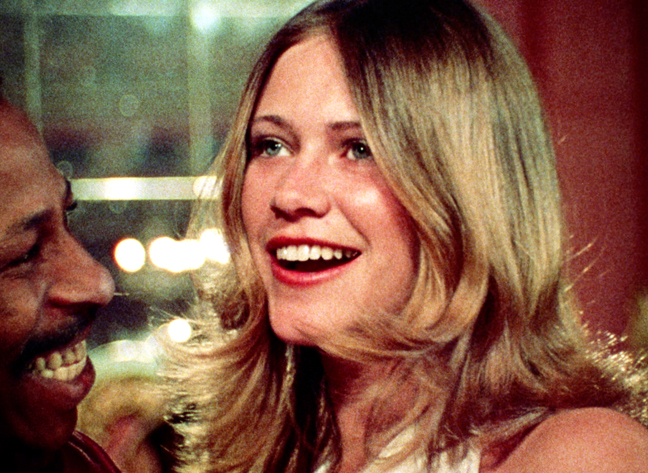
As for the actors, Artie was still hoping they could get Marilyn Chambers back for a leading role: “Marilyn was a hippie off the street when we found her,” he swaggered in February 1976. “Now she’s more confident. We don’t have a pact inked yet, but we’re planning three pictures with her – and the first is going to be ‘The Autobiography of a Flea.’”
His optimism was short-lived: Marilyn fell out with the Mitchell brothers when she decided to work exclusively with/for her new manager/beau, Chuck Traynor. Jim and Artie saw her new-found independence and interpreted it as betrayal: they had created her, made her into a household name, and were surely entitled to be part of the monetization of the next phase of her stardom. Spurned by their Eliza Doolittle, they retaliated, creating a knock-off documentary, Inside Marilyn Chambers (1976), using old footage without her approval. Marilyn felt ripped off by the unauthorized film, and betrayed by the men she’d considered her own brothers: a protracted and bitter schism ensued.
No matter: Jim had another actress he said he liked even more for the lead role of the virginal Belle. He’d first met Jean Jennings back in April 1975, when she’d flown into San Francisco to appear at a rival theater – the Sutter Cinema – to show her face and body to adoring fans as part of a promotional tour for The Defiance of Good (1975): ‘The lovely Jean Jennings! Free signed photos for the first 100 patrons,’ blared the advertising.
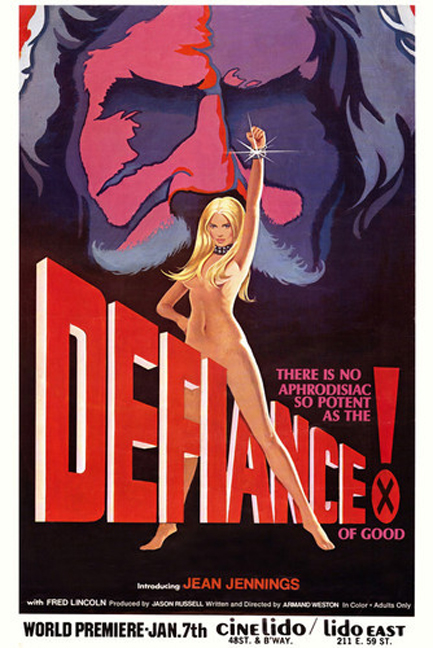
Jim sidled up to her, introduced himself, and was given an 8×12 headshot by the young actress. A little too young as it turned out: Jean was 17 when she made ‘Defiance’, a fact revealed by the film’s distributor, Mickey Zaffarano. Zaffarano protested his innocence – none-too-convincingly – to the Associated Press, who termed him “an unintentional cradle-robber.” “Now what do I do?’ Zaffarano said. ‘Can the law stop me from exhibiting? It’s hazy. It’s really not clear or obvious.’”
Despite the situation being as clear, obvious, and uncomfortable as a fat man in a phone booth, ‘Defiance’ continued to sell out theaters across the country, as newspapers picked up on the salacious story. Jean was described as “a Florida-born former cheerleader and granddaughter of a Baptist minister who turned to X-rated films after short stints as a coed, dancer, and model.” Jean attempted to defend herself, sidestepping the underage elephant in the room: “Sex on the screen has nothing to do with my personal life. I enjoy the stimulation of acting, not the sexual stimulation. It’s a professional stimulation.”
But nothing is quite as it seems in porn: decades later, Jason Russell, the director of ‘Defiance’ and erstwhile paramour of la Jennings, revealed to me that he and Mickey Z had decided to intentionally leak the underage story to boost their ticket sales.
Hey, it was the 1970s: what better way of selling tickets for a porn film than revealing your star was not barely legal, but rather, squarely illegal? Years after the fact, I tracked Jean Jennings down too – by then, a no-nonsense Florida soccer-mom who’d die in her 50s – and she was unperturbed by the memory. “Men,” she sighed. “Whatcha gonna do?”
Either way, Jim snapped up Jean for his next film. Rest assured, dear reader. She was 19 when she was cast in the lead role in ‘Flea.’
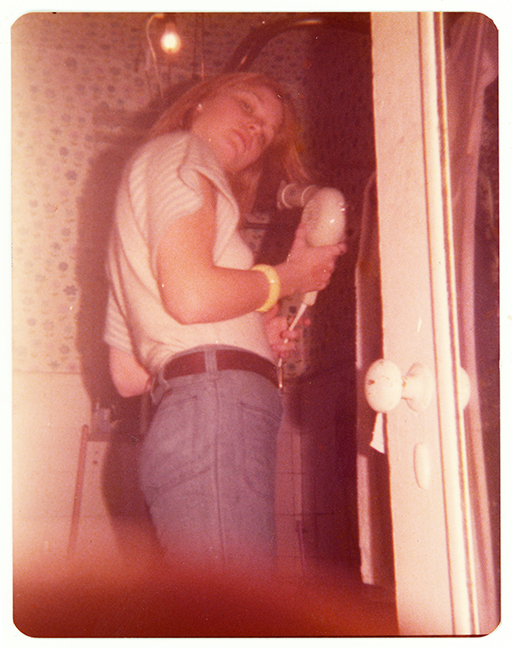 Jean (photo by Jamie Gillis)
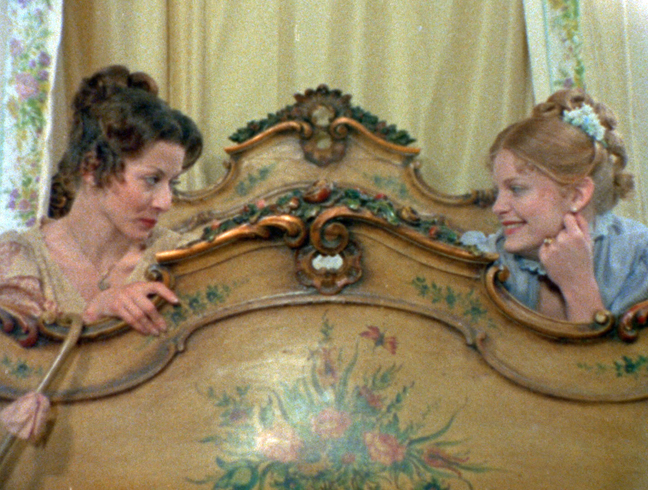
The rest of the actors in Sharon’s film were familiar faces from the Bay area sex film scene: John Holmes, who was flown up from Los Angeles for the month, had seemingly been in the business since the stone age, and looked like it too: a low-vaulted cranium, sloping forehead, and a joystick the length of a Mastodon trunk. John Leslie may have only started doing the Arriflex sex the previous year but had already built a healthy resume’ on both sides of the country, and character actors like Dale Meador and Ken Scudder were reliable, trustworthy performers. The angelic Annette Haven was 21, with a handful of film appearances and a portfolio of jobs as a nurse, exotic dancer, and masseuse, when she was chosen for ‘Flea.’
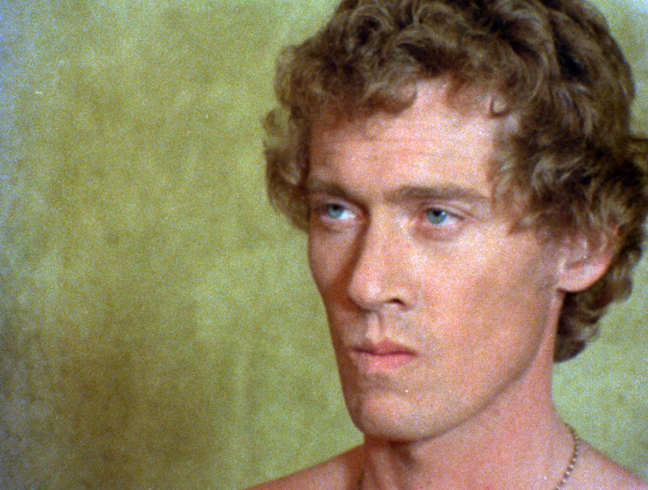 John Holmes
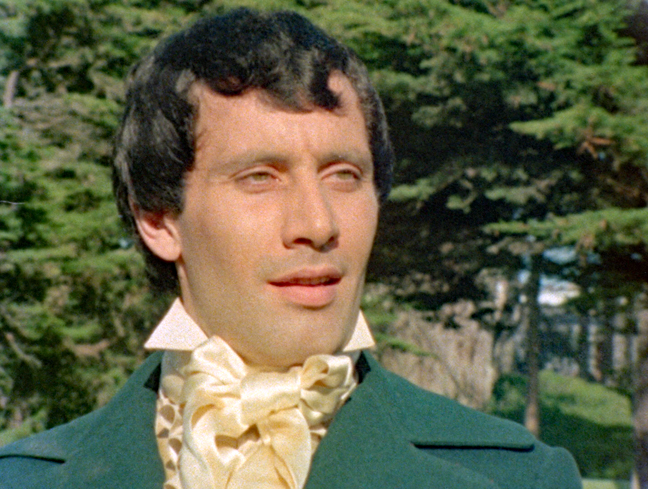 John Leslie
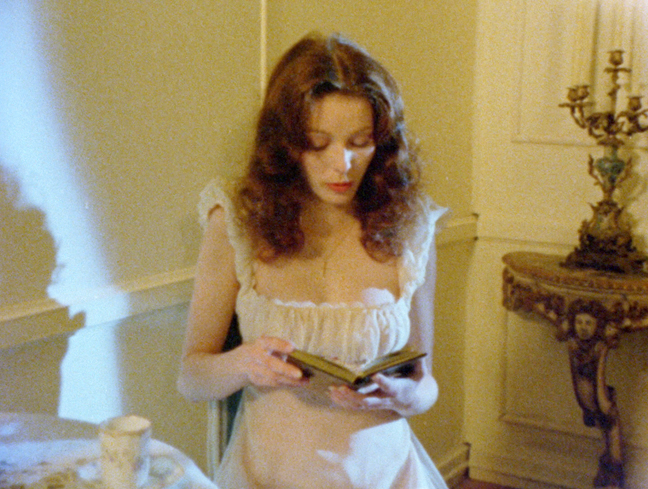 Annette Haven
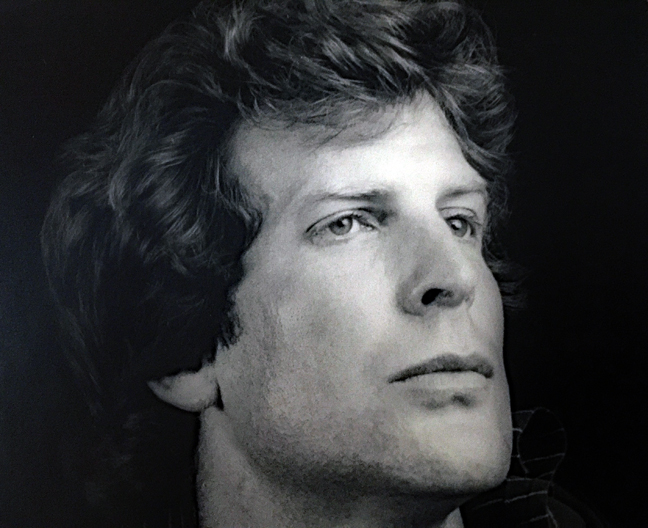
The biggest casting coup for ‘Flea’ was the selection of Philip Toubus for the role of the lustful priest. Philip was already a semi-legendary local figure, a handsome rake, well-known for his performances in the long-running ‘Beach Blanket Babylon.’ He was a bon viveur, allegedly from a rich family, with a remarkably accomplished musical theater career, having appeared in ‘Hair’ in Chicago and New York, and all of the various leading roles in ‘Jesus Christ Superstar’ on Broadway and in touring versions. He’d even turned up starring in Norman Jewison’s film adaptation. Fame and fortune beckoned but, simply put, Toubus preferred fucking. Lots of it. Stories of Toubus’ rampant libido were well-known around town, and the Mitchells didn’t have to twist his arm too hard to secure his presence – using a new name, Paul Thomas – for a series of hardcore loops in 1975, followed by a prominent role in their ‘C.B. Mamas’ early in 1976.
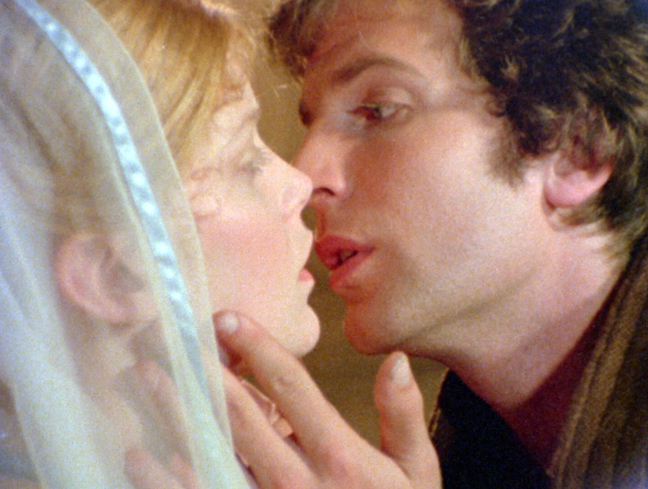 Paul Thomas
Not a lot of people noticed that Sharon herself made a blink-and-you’ll-miss-it appearance as a maid.
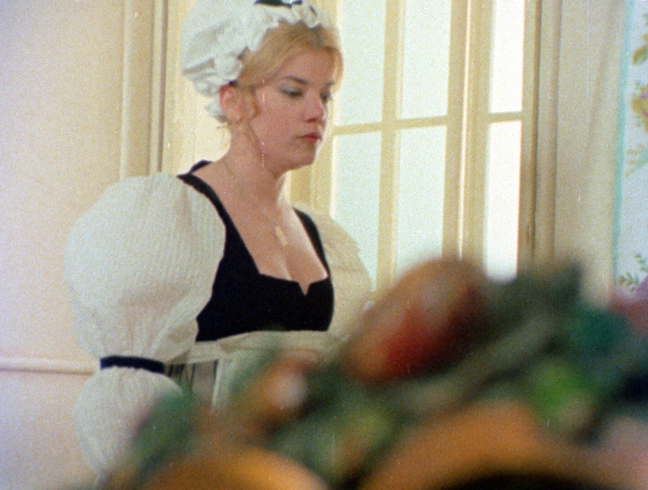 Sharon as the maid
And who was the voice of the flea who narrated the story? That was ‘Warren Pierce’, real name Morgan Upton, a member of the San Francisco improv group ‘The Committee’ who later went to act in movie hits such as ‘Peggy Sue Got Married’ (1986), ‘Sudden Impact’ (1983) and ‘No Small Affair’ (1984).
It was a large, experienced cast, not to mention a larger, even more experienced crew, but at times, Sharon still felt constrained: “I tried to bring some fresh female touches to the film,” she remembered, “but there were too many deadly sins we had to hit, so we had to make it bigger than life. Creative projects are always a battle of compromises, but we worked a lot of long days and got it done.”
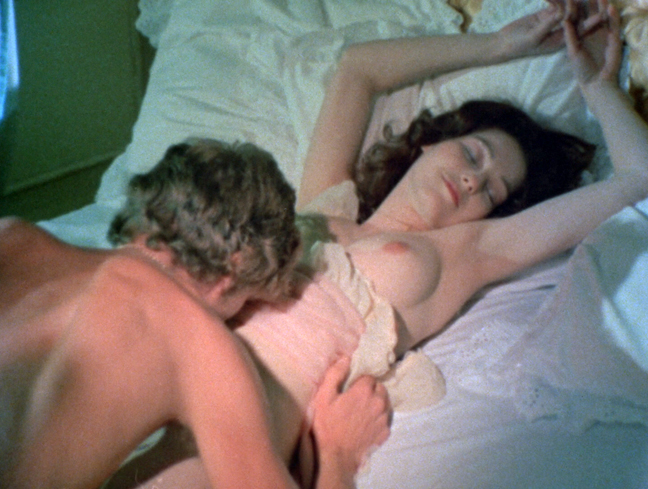
Other crew members have additional memories. Jack Harvey was a regular handyman who’d been adding rooms to the O’Farrell complex for years. Nicknamed ‘Fast’ because of his rapid-fire speech, he remembered his working days being even longer than Sharon’s: “Sharon turned ‘Flea’ into the best film that MBFG made. But she was a showbiz person, she wasn’t into porn, and so there wasn’t enough sex in it! After she was done with it, we had to sneak back into the studio and shoot the real close-up stuff which we cut back into the edit to add more sex to the film.”
*
‘The Autobiography of a Flea’ premiered on August 19, 1976 – and the first screening was a quiet affair of little consequence that nobody noticed, passing unobtrusively into the Bay summer breeze.
Of course it wasn’t. This is a fucking Mitchell Brothers production.
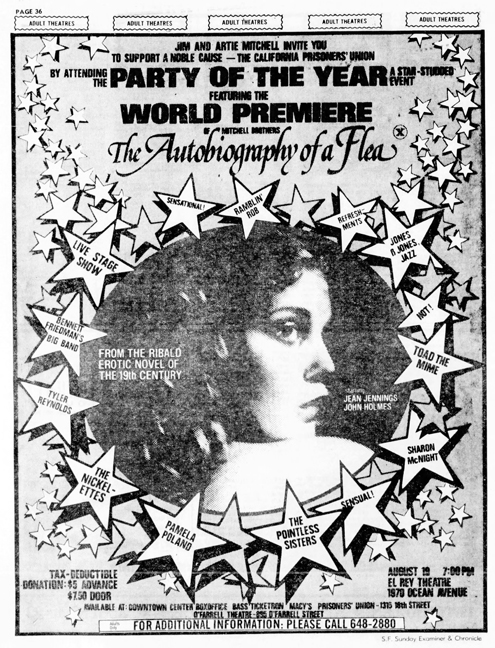
The full-page ad in The San Francisco Examiner bellowed, “Jim and Artie Mitchell invite you to support a noble cause – The California Prisoners’ Union – by attending the Party of the Year, a Star-Studded Event, featuring the World Premiere of ‘The Autobiography of a Flea.’” The brothers hired the El Rey Theater for the occasion, illuminating the night sky with klieg lights, and featuring attractions such as a live stage show starring the Nickelettes, Pamela Poland, Toad the Mime, The Pointless Sisters, Rambin’ Rob, Tyler Reynolds, Bennett Friedman’s Big Band (no, me neither), and a special guest – the woman of the moment – the director herself, Sharon McNight. It was attended by over 1,000 of the underground glitterati of the city, and featured speeches by local dignitaries, Sheriff of San Francisco, Richard Hongisto, and Assemblyman Art Torres. (Seriously though: how many porn films have premiered with enthusiastic endorsements from the local sheriff and a prominent politician? Every generation gets the porn it deserves, and we got ‘Shaving Ryan’s Privates.’) In the weeks that followed, ‘Flea’ played back at the O’Farrell, boosted by regualr special in-person appearances from Jean Jennings, Annette Haven, and Sharon McNight. (“With autographs!”)
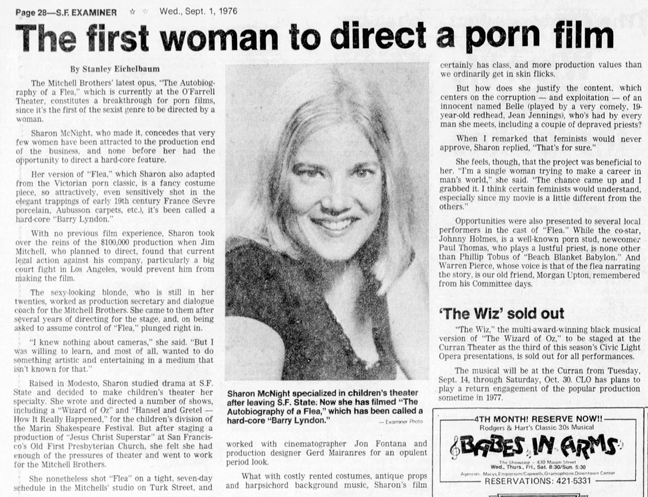
The ‘Flea’ market proved profitable, and the film became an instant cash cow – even if the reviews were mixed. There were the positive: “a fancy costume piece, so attractively, even sensitively shot in the elegant trappings of early 19th century France (Sèvres porcelain, Aubusson carpets), it’s the hardcore version of Barry Lyndon (1975),” declared the San Francisco Examiner. “A step forward in the evolution of erotic movies as legitimate entertainment,” chirped Hustler magazine,
The Oakland Tribune was less sanguine: “Flea is a flop as porn flicks go: I thought a woman’s touch might bring a little romance and tenderness to sex movies, but Sharon McNight’s ‘The Autobiography of a Flea’ quickly strips down to the same old porno picture grind.”
But beyond the actual merits of the film, the media, en masse, honed in breathlessly on the one aspect that obsessed them: this was a real sex film made by a real woman. A woman?! How could that be possible? Sharon’s promotion to director had turned out to be another Mitchell Brothers masterstroke of publicity.
By the time the film premiered, Sharon had gone back to musical theater and was appearing, rather incongruously given her recent work experience, as the evil sister, Ratschell, in ‘Beauty and the Beast’ put on by the Library Cultural Programs for children. Overnight she found herself inundated by requests for interviews and personal appearances relating to her porn opus: her opinions on sex were suddenly a valuable commodity. It seemed that everybody wanted to hear from this “sexy-looking blonde” and “unlikely porn purveyor.”
Under attention-grabbing headlines such as ‘The First Woman To Direct a Porn Film,’ ‘A Crusader for Pornography with Art and Meaning,’ and ‘Director Defends X-Rated Movies,’ a torrent of incredulous questions were lobbed in her direction like sexist grenades.
What made her think she could make an X-rated film? (“I’m a single woman, trying to make a career in a man’s world. The chance came up, and I grabbed it.”)
What was the experience like? (“The movie was my first. It was training. Going to Hard Knocks U. I was rookie of the year.”)
What did she think of the film she’d just made? (“I can’t look at it anymore. I just see all the mistakes.”)
How much money had she made from it? (“Less than $300 a week for endless hours on a seven-day shooting schedule. Less than any of the men who worked for me on the $100,000 production.”)
Didn’t the film’s rape scene glorify violence against women? (“The most important thing about the rape was at the end, when she taps her fingers on the ground with boredom. The significance of that was that Belle resisted the men. Once she had been physically overcome, Belle reacted with boredom, not ecstasy.”)
Who was the audience that this film aimed at? (“I wanted to appeal to women as well as men. Pornographic films haven’t given women anything they can see. This movie presents men in a more erotic sense. I deliberately avoided kinky stuff. It is pretty straight sex. I describe it as ‘pretty-core.’ Most pornographic films are presented from the point of view of men’s sexual fantasies. There isn’t a lesbian scene in this one. In the usual pornographic films, two women will be making love. Then the man appears on the scene and saves the day.”)
Who is showing up to watch the film? (“We’ve had a large turnout of women and couples in San Francisco. As soon as you give women something to see in X-rated films, they’ll come to see it.”)
What was she most proud of? (“The story has satire and humor. And a moral too: we’re all bloodsuckers.”)
Surely this wasn’t a film that feminists would approve of? (“That’s for sure. But I think certain feminists would understand, especially since my movie is a little different from the others.”)
What did she see as the future for adult films? (“Pornography must become an art form. It must have meaning and purpose. It must appeal equally to men and women. Pornography has got to straighten out its act. It’s got to get a whole lot more artistic. Pornography’s best defense is to become better, more creative drama.”)
What did she think of all the times that the Mitchells had faced prosecution for obscenity? (“I stand for free expression. Court trials for pornographic movie makers make me angry. A lot of my friends have been persecuted. Everyone has sexuality. There is no use in repression. Repression only leads to crime. Pornography is a cathartic way for sexual feeling which otherwise might erupt in rape on the street.”)
Sharon was even invited back to her hometown of Modesto to deliver a lecture at the local Koval Theater to promote the film. (She dutifully arrived in time to sing at her mother’s church on Sunday morning.) When she took to the stage, she announced to the crowd, “You’re all 18, nobody forced you in here. The fact you can look at this film and not feel embarrassed says something good about your sexuality.” Sharon said her film focused on a gradual sexual awareness of a Victorian maiden: “It was shot in seven days on $100,000 budget. Don’t expect Star Wars.”
At the end of the event, she took questions from the audience. One person shouted, “How can I become a porn star?”
Doing her best Mae West voice, Sharon replied, “I’ll audition you later.”
In the decades that followed, Sharon McNight continued working for the MBFG and the O’Farrell, even returning to the porn frontline when she produced, wrote, and directed ‘Behind the Green Door: The Sequel’ (1986) for the brothers a decade later.
Her singing career flourished, and in her words, “I played everywhere from Moose Hall to Carnegie Hall and anywhere the check doesn’t bounce.” She accumulated awards (six San Francisco Cabaret Gold awards, 3 Cable Car awards, Tony-nominations, and more) and plaudits (the Los Angeles Times called her “one of the great wonders of the musical stage” and in 2010, she was chosen as one of the 50 most influential people in cabaret.)
 Sharon
*
Back in Soho, (London, that is), I’m nursing one of Thirst Bar’s “awesome range of gins,” while contemplating how Edward Avery’s pornographic publishing empire came to an end over a century earlier.
After successfully evading prosecution for many years, he was finally arrested in 1900 for selling two obscene works, ‘Flossie, a Venus of Fifteen’ and ‘The Ups and Downs of Life’, out of his shop on Greek Street.
Newspapers of the era reported that “they were very small books and could be read in a very short time, but they were grossly offensive on every page.” A number of flagrantly obscene photographs and prints were also found. (The Chief Inspector) said the case was “the worst that had ever come under his notice, with thousands of shocking books having been seized.” Avery was convicted the same year, his stock was destroyed, and he retired from business, a broken man, declaring bankruptcy the following year.
‘The Autobiography of a Flea’ made a lot of money for many people over the years. Not bad for a publication dismissed as being a ‘potboiler.’ I wonder what Avery would have made of its success.
As I leave the bar, I look up at the present-day business that occupies the upstairs space. That was the area where Avery secretly stored the obscene and illegal tomes away from prying eyes. It’s now the headquarters of a media production company, responsible for over 80 international award-winning feature films and TV series to date, including the Oscar and BAFTA award-winning ‘The Last King of Scotland’ and ‘The Constant Gardener,’ as well as David Simon’s Emmy-winning HBO series, ‘Generation Kill.’
I noticed the name of this successful company is Potboiler Productions.
*
*

Some of the finest damn film writing I’ve come across.
Thanks so much Bez!
I was vaguely familiar with this film and had no great desire to see it………. but having read this, I am keen to get a copy and watch it. Love this story and the author deserves an award for the writing! Congrats… and more please!
We really appreciate that Jane!
Awesome Article Keep Up Good Work
Thanks as always Jeff!
“The ‘Flea’ market proved profitable…” All right, Ashley West. How long have you been waiting to use that one? How many years have you been saving it up? HOW LONG, mate?
Busted!
Always been curious about the actress “Joanna Hilden”, who plays Julia Delmont (John Leslie’s character’s daughter) ; seems she only ever appeared in this one film.
potboiler productions?
and now millions know that?
thats why we need the rialtoreport!
gin gin!
Thanks so much Bernd!