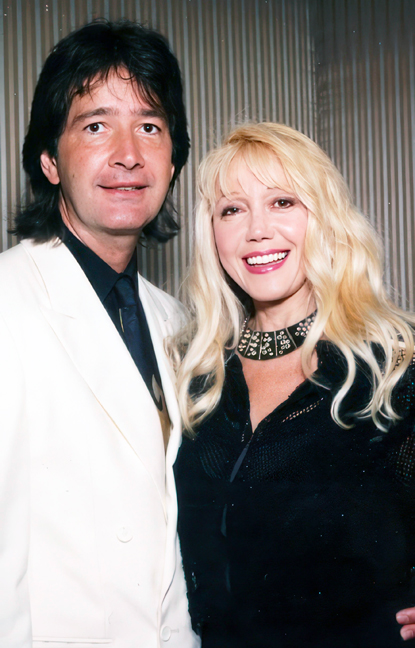
David Frazer and Svetlana were the premier couple of sun-kissed west coast adult films in the 1980s. Their movies embodied many of the qualities of the golden age – erotic plots unfolding in exotic locations, shot on film with high budgets and impressive production values.
Movies such as Ultra Flesh (1980), F (1980), Bad Girls (1981), Pink Lagoon (1984), and Surrender in Paradise (1985), featuring the biggest stars of the time, such as Traci Lords, Seka, Ginger Lynn and Annette Haven, dominated the box office each year.
But as successful and ubiquitous as their films were, David and Svetlana themselves remained firmly in the background, rarely making public appearances, seldom giving interviews, and preferring relative anonymity.
The Rialto Report approached the couple many times over the years, keen on hearing about their experiences and memories of the adult film business, but David and Svetlana continued to maintain their privacy and always declined to talk on the record. (We told part of Svetlana’s earlier, pre-David story when we interviewed her first husband, the director Jaacov Jaacovi.)
We were sad to hear that Svetlana passed recently, and after much reflection, David agreed to share his memories on his life and work with Svetlana.
With special thanks to David. Learn more about his current-day photography and videography and read his novel ‘Into the Abyss’. All personal photos property of David Marsh.
————————————————————————————————————————————————————–
1. David Frazer – Beginnings
Where do you hail from?
I grew up in London. I was born at the Welbeck Hospital – the same hospital where Sarah Ferguson, the former Duchess of York was born.
What was your upbringing like?
In my earliest years, I was brought up in relative luxury. I lived in mansions with servants and housekeepers and everything.
Where did the money come from?
My father came from an immensely wealthy Jewish family – his mother, my grandmum Agnes, was like a bank.
What was your father like?
First and foremost, he was absolutely smitten with films. He was friends with the actor David Niven. So he used the family money to buy a chain of cinemas in Britain that he named the Nigel Marsh Theatre Circuit.
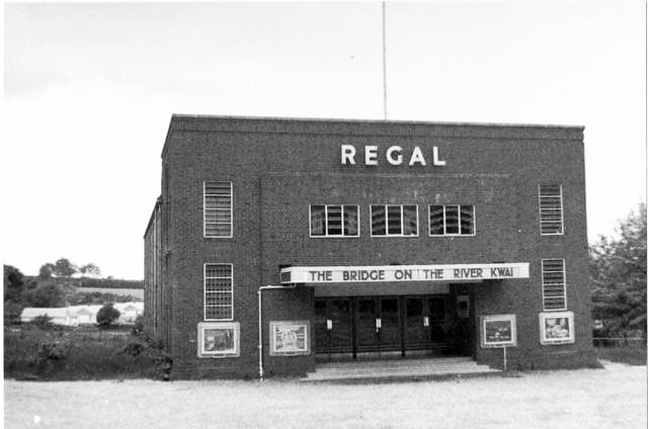 One of the Nigel Marsh theatres
But he bought the cinemas at the absolutely worst time because all of a sudden, movies weren’t making big bucks in England anymore. Television had come out and people were just crazy about it, so they were staying home instead of going to the cinema. And the way the taxation system worked in England back then was that cinemas paid tax on how many seats they had – so my mum told my father to rip out a bunch of the seats because the tax was killing them. We wound up with cinemas but not enough seats to fill them.
My father also tried his hand at TV – he made the very first of the ‘So You Think You Can…’ television franchises. It was called “So You Think You Can Drive”.
But bottom line, he lost everything. Really because he was just an idiot (laughing).
Was that stressful for you as a family?
For most of my childhood, I remember my mum and dad fighting all the time. Fighting because of financial worries, because everything collapsed. I remember my father on the floor of the living room in his dressing gown, his hair a mess, surrounded by papers – not even at a desk – just manic. I hated it.
The shouting in the house was so stressful. My mother used to yell at my Dad, “Your father will be turning in his grave, you idiot.” If I said anything he would shout at me. I had two sisters and we were all absolutely terrified of my Dad. It made me incredibly reserved, very timid.
That’s frightening…
Yes, I was just scared – scared out of my wits about everything. Today I understand that my father was probably out of his mind because he’d lost everything. He’d had everything and he lost everything. He was an only child, and so he lost the entire family fortune.
But there was one good thing – my father had been in the film business, and I had cousins in the film business. And that’s why I ended up in the film business.
Did your father help you break into the business?
Yes – that’s one of the few positive things my dad did for me. When I was around 17, he introduced me to a film editor named Jack Knight and Jack helped me get a position as a supernumerary at Pinewood Film Studios.
What’s a supernumerary?
It’s kind of like a paid internship – a hands-on film school where you are trained to do all sorts of things: I learned how to edit 35mm film on flatbeds, how to load a magazine for a camera. Sure, I also had to bring tea to the directors because it was the lowest position, but it was a really fantastic training.
From Pinewood I wound up working on a movie at Twickenham Film Studios and, through that, I got a gig at Thames Television as an editor on The World At War about World War II. The project was already in progress when I joined. They liked my energy, so I got that gig.
That is a monumental British documentary television series.
Yes, it won many awards and has stood the test of time.
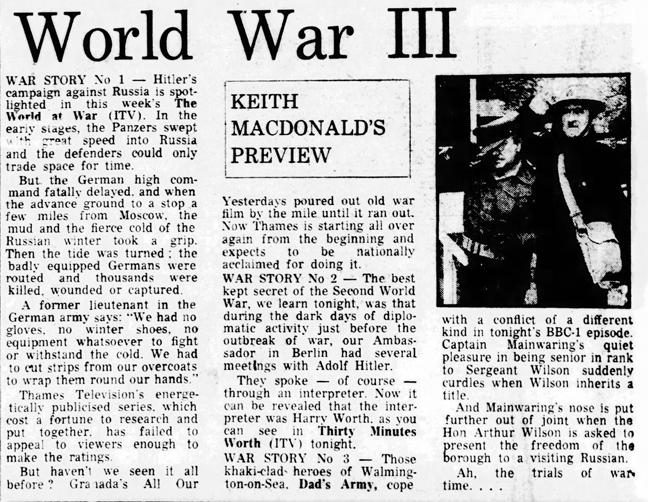 Promotional article for The World at War
Were you living in London while you were working on that?
Yes – I got a place in the Barbican.
That was late 1960s London – what was it like?
Well, I wasn’t into drugs, and they were everywhere at the time. But I did like to dance. I used to frequent a club called Valbonne. I was a good dancer even though I was so shy. I hardly ever asked any girls to dance – luckily the girls would usually ask me.
But I did meet my first girlfriend at Valbonne – we both loved to dance. We went steady for about two years. She also had very wealthy parents like mine had been – but since we weren’t wealthy anymore, her parents never thought that I was good enough for her. So the relationship ended.
Was it a fun time in London at that time?
I was having fun during those years. I traveled too: one of my sisters fell for a guy she met in Israel – a French Israeli Moroccan who went on to head a fashion house in Paris. I would drive from London down to Dover, jump on the hovercraft, and then drive from Calais or Boulogne to Paris to spend time with them. That was a trip.
But film was always your passion?
Actually, writing was my passion. I loved to read, so I thought I’d write for a living and I started working on my first book.
But yes, I also wanted to direct films. And I knew that if I stayed in England, it would take me forever to become a director. England was so slow back then and I knew it would take 15 years or more to get anywhere. I was only 23, 24, and shitting myself thinking I wouldn’t make it until I’m 40?! I couldn’t wait that long, you know? So I thought, let me go to America.
So I did.
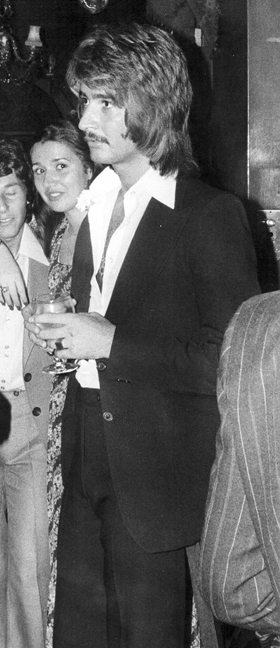 David Marsh
*
2. Coming to America
When exactly did you arrive in the States?
I landed at JFK airport in New York for Christmas 1976.
What was the plan?
There was no plan! I had no idea what I was going to do.
I stayed the first night in a hotel, treated myself. Then I got on a train to go upstate New York to see my parents’ good friends who’d always been lovely to me and my sisters. I stayed with them for a while, but I wanted to be closer to the action. I had a little money, so I headed back to Manhattan and spent a few weeks there, hanging out, making some friends – just getting a taste of America.
And then presumably your money ran out?
Yes, it was very expensive in Manhattan (laughing). One of the new guys I met said he had friends in Florida, so we decided to go there. We did that thing where you drive somebody’s car down the coast. We left Manhattan where it was freezing and all of a sudden when we got to the panhandle, it was baking.
We got to Miami and I checked into a little place called the Castaway Motel. The Playboy Bunny convention was taking place nearby. This was 1976 going into 1977 so it was the heyday of Playboy magazine. That was a crazy scene.
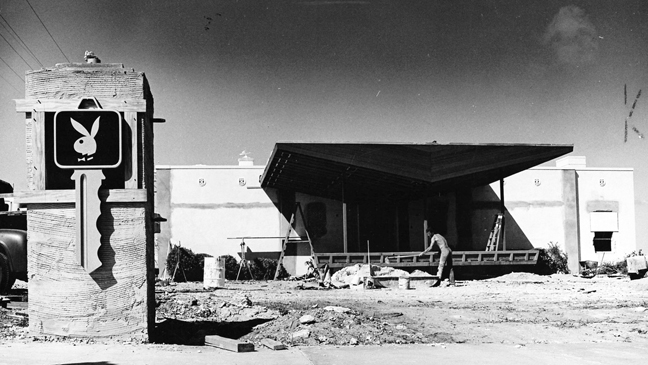 The Playboy Club being built in Miami in 1961
What was your time in Miami like?
Well, it got a little bit sordid, I’m not gonna lie (laughing) – in a fun way.
But it turned out Miami was too expensive for me as well. A new friend I made had stayed with a family in the Dominican Republic and he said we should head there, so we went to the DR. When we arrived, the family he’d stayed with wasn’t there anymore so that fell through. But everything was cheap, so I found a little place in the middle of nowhere near the beach. Just cows and nothing else. I was the only white person and I didn’t speak Spanish, but I met some locals and they took me everywhere.
I spent a few weeks there before heading back to the States. I flew to Miami and then boarded a bus straight for Los Angeles. It was time for me to start a career, and I knew I had to find my way to L.A. if I wanted to be in the film business.
It was like the old saying “Go West, young man”.
Did you know anybody in California when you arrived?
My father had a second cousin in L.A. named Raymond Stross. Raymond was a film producer who started in the UK but had moved over to the States around 1950. He’d made quite a few films and was married to the actress Anne Heywood. They were known for making movies with a more frank take on sexuality than was typical of the time.
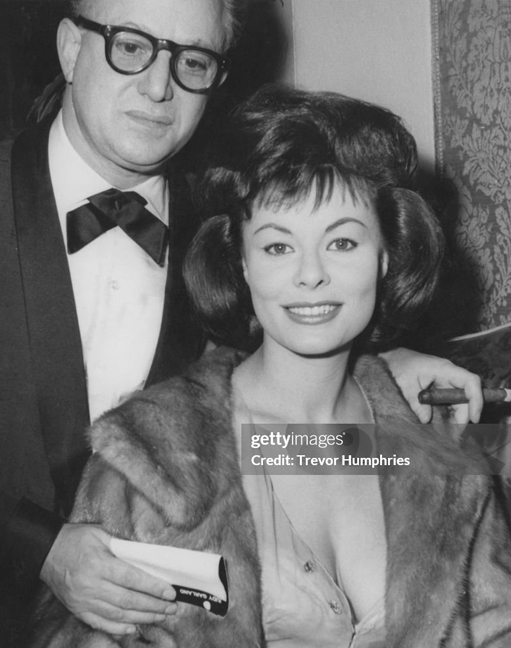 Raymond Stross and his wife Anne Heywood
So I went to see Raymond thinking that he would facilitate my entry into the film business. He lived in a fantastic place in the Hollywood Hills, but he wouldn’t let me stay with him. He just gave me $50 and I was too much of an idiot not to say, “It’s okay, I don’t need your money.” I just took it and never spoke to him ever again, even though I did go to his funeral years later (laughs).
With the little money I had, I found a place to stay. And then I met Hallie. I can’t recall how we met, and she wasn’t really my type, but she really wanted to date me. She was a very sweet Jewish girl who still lived with her parents. I’m Jewish so I wound up spending a lot of time with her and her family.
Hallie was very sweet. She was the one who connected me to the L.A. film community. She knew everybody. She said to me, “You know who you’re gonna get along with? My friend, Elly – you two will get on like a house on fire.” So she introduced me to Elly, who was a filmmaker from Israel working in L.A.
Did Elly help you find work?
He introduced me around and I started to pick up some editing jobs – we called it working the cutting rooms. Later I did sound mixing for MGM on a film called ‘A Great Ride’ (1979) – I used the money from that to buy a little used Fiat. I just took gigs where I could get them – cutting sound reels and sound effects. It was all 35 millimeter work and you got paid by the reel back then.
How did you move beyond working by the reel?
It was Hallie again. She said, “You know, I can get a job for you.” And she did.
The work was on a film with Wes Craven called The Hills Have Eyes. This was before Wes was well known. When I met him, Wes didn’t even have a place to sleep. But here he was directing this horror film. The producer of the film, Peter Locke, didn’t have any money either.
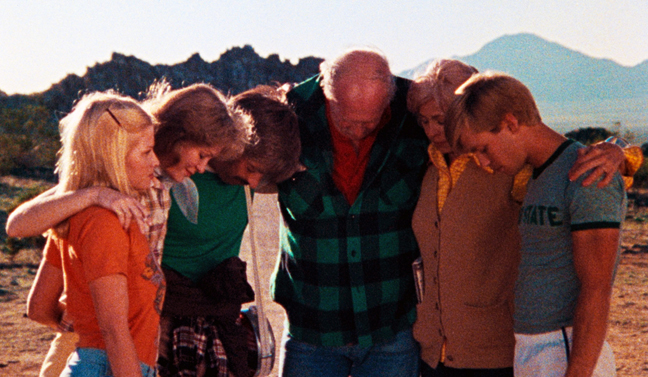 ‘The Hills Have Eyes’
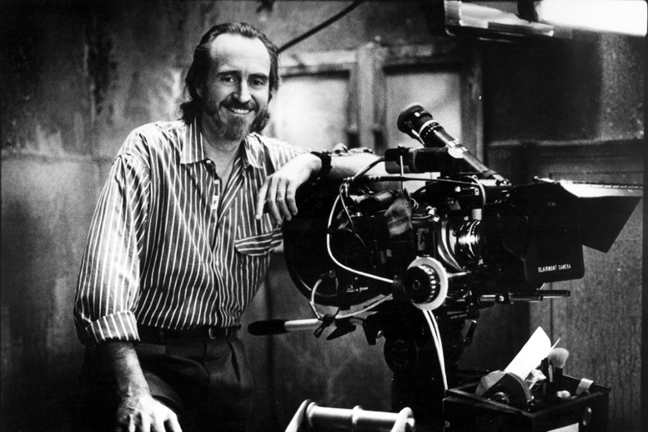 Wes Craven
Peter, Wes, an editor named Peter Hitchcock, and I all worked together on the movie. We filmed it in this home in Westwood. We’d shoot until we couldn’t keep our eyes open, then we’d curl up on the floor and sleep, then get up and keep filming. It was work, sleep, work, sleep, work, sleep. It wasn’t paid well, but it was a legit job. And of course, that film went on to make a lot of money and catapult Wes’ career.
What about the producer Peter Locke?
‘Hills’ was really Peter’s project. He was a bit austere, but we got along and he liked me. After we finished the movie, he got me work on a children’s television series. I did that for a while, but the show never really got off the ground.
Was the plan to stay in Los Angeles at this point?
Well, I had a decision to make. I was in the States on a three-month tourist visa, and it was running out. I saw the clock counting down and was confronted with going back to England and being considered a failure. I’d told everybody – I bragged probably – that I was gonna make it in America, I was gonna be a director, you’ll see. I just couldn’t go back (laughs).
So, all of a sudden, I was an illegal. And I needed money.
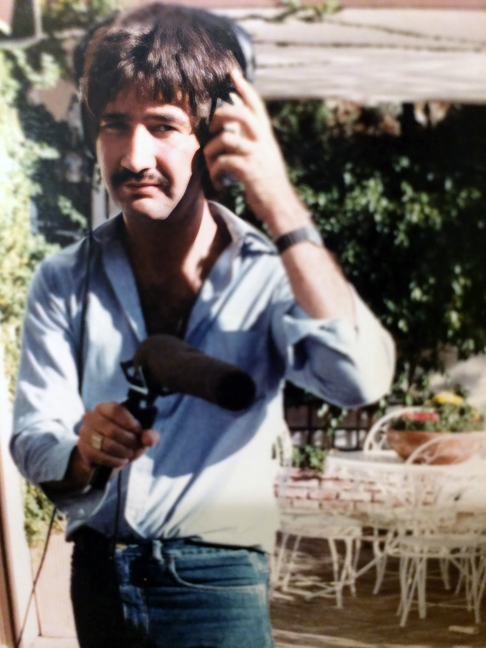 David
David
*
3. Meeting Svetlana
So what was next in terms of making money?
Elly – the Israeli film producer my then girlfriend Hallie introduced me to – told me he was working on a 16 millimeter feature and needed some help. What he didn’t tell me was what type of movie it was.
And what was that?
It was a porno… Wow! It was like at the doctor’s office. Everything was out in the open (laughing). And then the penny dropped.
It was the first time I’d ever seen a porno. Well, I’d seen Emmanuelle, the French erotic movie. And that was an interesting piece of filmmaking. But it wasn’t hardcore. ‘Emmanuelle’ was very tasteful, very beautiful – and it was sexy and arousing. You couldn’t help but get a boner, you know? (laughing).
Elly showed me some footage of the film they’d been shooting.
What was your reaction?
I just couldn’t understand it. It was hardcore sex but there was nothing arousing about it. I didn’t know if I wanted to get involved. But Elly convinced me that I should. He said, “Okay, look, I get it. But it’s fairly decent pay, you know? We’ll make something together. It’s all good.”
What film was it?
It was a movie called Little Orphan Dusty, and it was produced and directed by a guy named Jaacov Jaacovi. I met Jaacov – or Jake as we called him. I liked him. He was Israeli and I knew a lot of Israelis, so I got his vibe. We immediately started talking about where to get good falafel in L.A. But I didn’t tell him that I thought his film was atrocious (laughs).
Anyway, whatever the work was, it was still better than me going back to England with my tail between my legs.
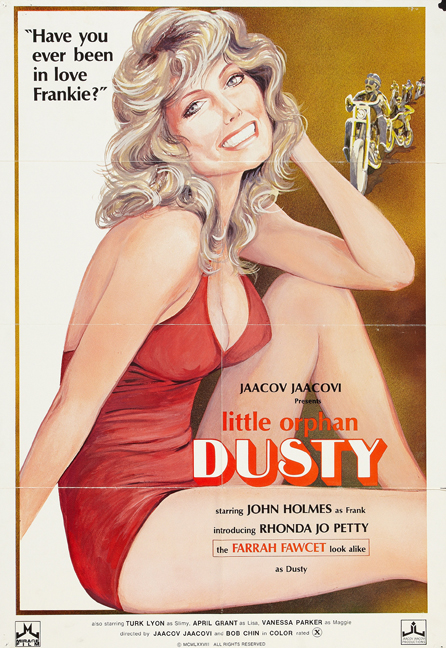
What did you do on the film?
Jaacov and Elly had me splicing everything, keeping it all in sync. You know, it wasn’t like video where everything automatically syncs. With film you have separate picture and sound tracks. If you lose a trim, all of a sudden you’ve got a piece of dead sound, you know?
Did you meet Svetlana on ‘Little Orphan Dusty’? She was married to Jaacov at the time…
No. Even though she co-wrote and co-produced the film with Jaacov, I didn’t meet her then.
So where did you meet Svetlana for the first time?
It was on the set of her film 800 Fantasy Lane. I don’t remember how I wound up on that set, but I did some exterior shots for the movie – a gas station, some fancy mansion, things like that.
And what were your first impressions of her?
She was drop-dead gorgeous. I mean, really, really stunning. She was just a beauty beyond belief. And she seemed so out of place on an adult film set. She didn’t have an ‘X aura’ about her.
At the end of the shoot, everybody was gathered around her and she was writing checks. When it was finally my turn, she looked at me in a lingering way and just said, “Well, thank you very much.” I thought that she eyed me a little bit, but I wasn’t sure.
I asked Elly about her and he told me that she’d been married to Jake but that they’d separated and weren’t together anymore.
I was intrigued, but she hightailed it with the crew to San Francisco to finish the film.
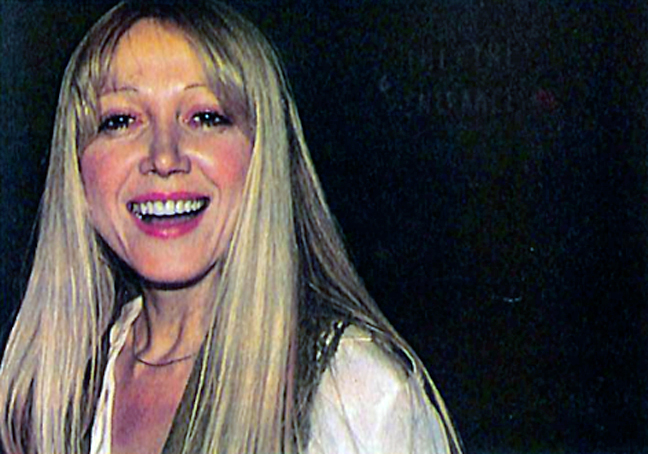 Svetlana
When did you next connect with her?
It was maybe a month later, after she and the cast returned from San Francisco. I was helping Elly in the cutting room editing the film. And that’s where I heard some stories about her.
Like what stories?
Like how the crew nearly mutinied while they were up in San Francisco because of her. That things got rough, and it was Jamie Gillis who supposedly stepped in and held the shoot together.
It didn’t click for me because that wasn’t my initial impression of her at all.
How did you and Svetlana get together romantically?
She called to ask me out on a date! I was definitely nervous on the phone. I was so smitten by her looks but she also intimidated me (laughing).
I was living with two roommates at the time, Tony and Ian, and they heard me hesitating on the call. They were mouthing “Go, you idiot, go, go, go, go, go!”
So I went… and in about a week later, we were living together. And after about a month, when we were in bed together one day, Svetlana said to me, “You know… you’re going to marry me.”
Did she tell you much about her previous marriage to Jaacov?
Yeah, she told me what a womanizer Jake was. That he was cheating on her all the time. She said it was awful.
She also said he was lazy. They had been living in Svetlana’s mother’s house, and her mother was helping them financially because Jake wasn’t working at first. Svetlana said, “Get a job, do something,” but he never did. So she wound up signing him up for a course on how to operate a camera. She wrote several scripts and was thinking they would be partners. But apparently, as soon as Jake learned how to use a camera, he didn’t want her on any project he worked on.
What did Jaacov make to your relationship with Svetlana?
He didn’t like it. He told me, “You’re making a mistake,” and he told Svetlana, “You can’t marry him, he’s just a waste of your time, it’s gonna be over soon.” He told her I was going out with other girls – which I wasn’t. It was just jealousy on his part.
What was Svetlana’s background?
She came from Ukraine. But that was in the post-war Soviet era – difficult times – so her family pretended to be Polish and moved to Poland. That’s where Svetlana grew up. She had an older brother and two older sisters. That whole time in Poland was very tough for all of them.
What did Svetlana tell you what she was like as a child?
She said she did well in school and that she was a talented pianist. In fact, she thought she was going to go professional until she became enamored with acting. After she caught the bug, acting was always in her mind, heart, and soul.
She grew up in a traditional Catholic household, but she struggled with organized religion. When she was a teenager and went to confession one day, she shared her impure thoughts and her schoolgirl sexual exploration. The priest chastised her and said he couldn’t give her communion unless she promised never to do those things again. So… no communion ever again for Svetlana.
How did Svetlana make it to the United States?
When she was 16, the family got permission to emigrate to Chicago. Her brother had become a doctor and was already in the U.S. so he sponsored the family. When they arrived, Svetlana’s father – who was intelligent and had a professional job in Poland – ended up doing menial, night watchman jobs because that was all he could get. It was sad: he worked in a place with toxic chemicals, ended up contracting leukemia, and died as a result.
What did Svetlana do in Chicago after she finished school?
She got a job at the Playboy Club. If you were in Chicago and drop-dead gorgeous, it was rather fashionable to work at the club at that time. All the high rollers would tip enormous sums of money.
Hugh Hefner was all over her – as was his brother Keith. Svetlana said Keith almost raped her one night. Things came to a head, and Svetlana was fired from the club. But a week or so later, she went back in a black wig and with a different style of makeup – and got re-hired without being recognized. She was making so much money from the tips that she just wanted to be back there.
How did Svetlana wind up in California?
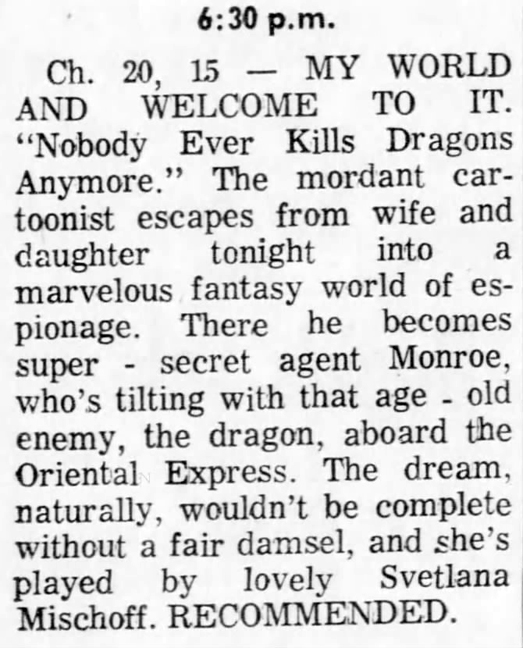
She wanted to be a movie star. So she got herself to California and got on the TV show ‘My World and Welcome to It’ (1969-70) and picked up a handful of other gigs. She had a small part in a film with Raquel Welch who didn’t like Svetlana and had her fired – competition probably. Then she went on talk shows like the Steve Allen show – he had her back a few times, she went to the Golden Globe Awards, and met Al Ruddy, the producer of The Godfather (1972). He wanted to make Svetlana a star but ultimately said he couldn’t because of her accent. In those days you couldn’t get anywhere with a foreign accent – you had to be American as apple pie.
So she was doing a bunch of stuff, but nothing big was materializing. Her most regular gig was a recurring spot on The Gong Show (1976-80). She won that first show – and when they awarded her a carrot bouquet, she started chewing on it like a donkey. She had everyone in stitches and returned as a regular contestant because they found her so dynamic and funny.
*
4. A Porn Partnership
What was the first movie that you and Svetlana made together?
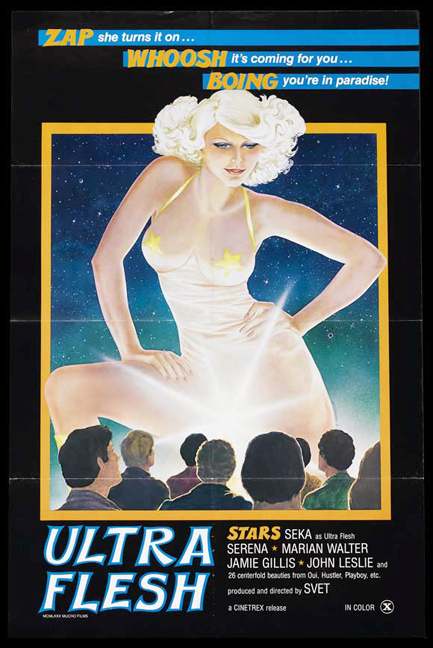
‘Ultraflesh’ (1980) was the first. I wrote it though I think the credits say it was both Svetlana and me. Basically t was a re-write of a smutty thing that Elly and I had created together that never went anywhere. It was pretty ambitious for an X-rated film as it was science-fiction themed. It had a cast of about 40 or 50. It starred Seka who was a big name at the time.
What do you remember about Seka?
Svetlana and I went over to her house for coffee. She presented totally normal, not slutty at all. She understood her value and she was really professional. She came off almost like a country girl, but when she got on set… she became this sex goddess.
What was the early experience of working with your romantic partner on an adult film production like for you?
It was a bit strange. But I never thought that adult films were going to be a career or anything. And Svetlana didn’t think that either. We both had mainstream ambitions.
You mentioned that on ‘800 Fantasy Lane’ the cast had almost mutinied against her. Was there any friction between you and Svetlana when you started working together?
Not really. One time early on we had a little problem, but it smoothed over really quickly. I think in part because I have a very easy-going personality. I’m also the kind of director that even if something is dreadful, I don’t say that. I just work things out a different way.
With me, Svetlana was just lovely. The closer we grew, the more supportive she became of my dreams. I never saw that stringent side of her with other people on set.
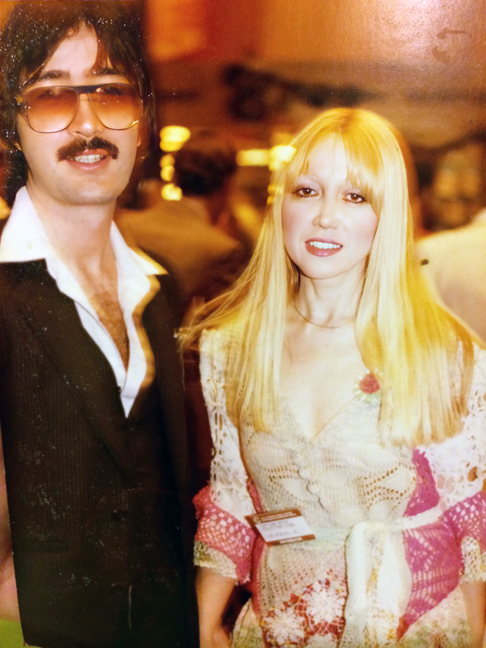
Orson Welles’ cinematographer Gary Graver worked on Ultra Flesh with you both…
Yes! We were lucky enough to work with Gary several times. Gary was such a good cameraman and such a fast worker too.
This story is from later, but it will tell you everything about working with Gary. In the mid-1990s, I shot a film called ‘Stormswept’ (1995) in Louisiana. I was initially working with a dreadfully slow cinematographer and an art director who was a drunk and didn’t deliver any of the goods. To make matters worse, it was constantly raining. It was so horrible, I cried. I cried because it was such an expensive film to make and it was going so badly.
When I returned to Los Angeles, I still hadn’t finished production. I didn’t even have enough to hold the movie together. Svetlana said, “Well, it’s an unfinished film. First time that’s ever happened to us!” And I felt terrible, because I’m helming this thing on my own – Svetlana wasn’t involved. And like I said… it was expensive.
Svetlana suggested that I call Gary, so I did. We met up and I showed him what I’d shot. He immediately leaned in to help. We laid out what I needed to finish the film and he said, “OK – we’re going to do this in four days.” I’d shot for seven weeks in Louisiana but with Gary, we got it done in four days.
I had a friend of mine build the sets – we needed to create a sex dungeon because it was a horror sex story. I told Gary that I wanted a lot of crossovers – actors walking towards you instead of following you, you cross them and sweep around them. The original cinematographer in Louisiana had pushed back when I asked for that – but with Gary it was no problem. He was just such a funny, sweet, and lovely guy. Just straight down to business.
Later on, you also worked with another well-regarded cinematographer named João Fernandes who was DP on the breakout adult film Deep Throat…
He did ‘Deep Throat’? Interesting – he never mentioned that.
Svetlana and I became reasonably good friends with João – which was unique, because it was difficult to have friends with Svetlana. And João was a bit guarded like me. Very, very talented like Gary.
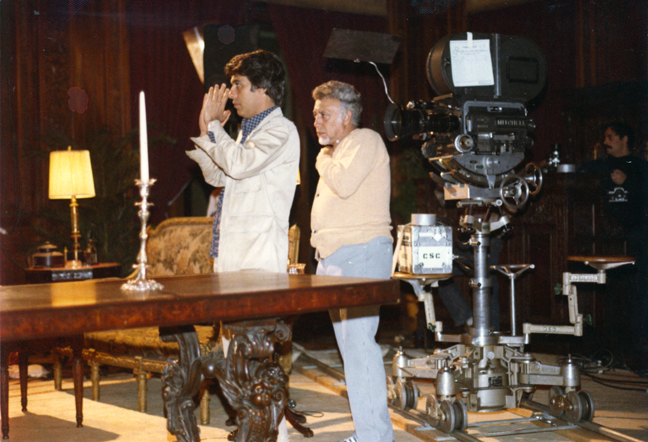 João Fernandes (left) with Gerard Damiano
Why was it difficult for you and Svetlana to have friends together?
Here’s a perfect example: when Svetlana first called and asked me out, I mentioned that I had two roommates. One of them, Ian, drank a lot. Not long after Svetlana first met him, she put him in his place about it. She told Ian that he was a bad influence on me and said he shouldn’t hang around us.
That was who she was. Svetlana was just very direct with people, which made it difficult to make friends. She could be very blunt – she had no filters at all. That’s why some people in the X film business thought that she was hard on them. If something was terrible, she would say something snarky. We understood why much later when Svetlana was diagnosed with Asperger’s Syndrome.
But it’s not who she was inside. I quickly realized this, so it was never a problem between us. Like I said, Svetlana was always nurturing with me, like a thermal blanket. She was the most positive person I’ve ever met. She was the star, but she immediately encouraged me and put me in the driving seat.
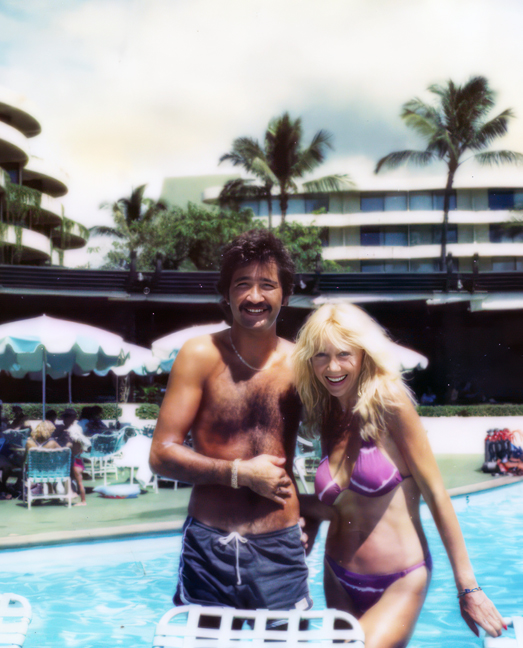 David & Svetlana
Did that include on the films?
Absolutely. I was influencing the films from the moment I met Svetlana. For example, I guided some of the sexier scenes in the film ‘F’ (1980). I told her I didn’t find adult films erotic because they jumped into the sex too quickly. You need to feel a passion building. You need moments where you can get horny.
Another cinematographer you frequently worked with was Gene Petrov – what can you tell me about him?
His real name was Eugene Shlugleit and he went on to work on some more mainstream films like ‘Evil Dead II’ (1987).
He didn’t work always well together with Svetlana – he didn’t like taking directions from her. But he was very good with me. I liked working with him. He wasn’t as good and as fast as Gary or João but he was fine for what we needed.
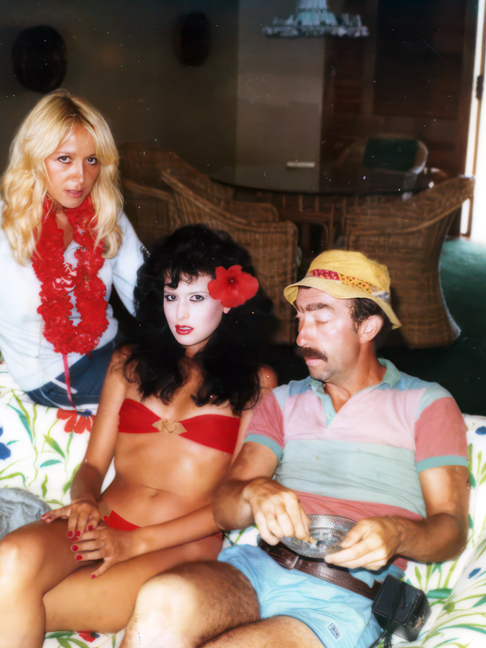 Gene (right) with Svetlana (left)
After ‘Ultra Flesh,’ you and Svetlana went on to make ‘F,’ correct?
Yeah, that sounds about right. I wrote ‘F’, and Svetlana and I split the director duties.
What do you remember about Annette Haven, the star of ‘F’?
She was really, really nasty. She acted like a total prima donna and it really affected the flow of filmmaking. To put it bluntly, she was a cunt.
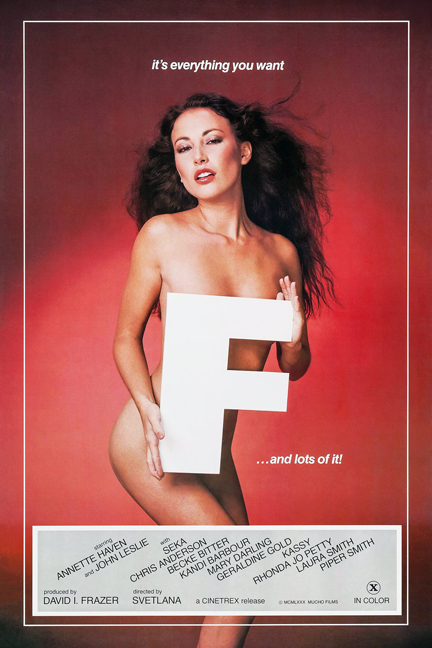
After ‘F’ came ‘Sex Boat’ (1980)?
Correct. Svetlana pretty well produced ‘Sex Boat’ and I directed it. VCX put up the money for the film, so they owned it. They attached another producer who was always breathing down my neck.
There were a lot of things I didn’t care for on that production.
Is that why you and Svetlana started a company – Cinetrex – to produce your own films?
Actually, we started Cinetrex to distribute our films. We were getting burned by everybody on distribution. Sidney Niekirk had burnt Svetlana. And Danny Mamaine burnt us both on ‘Ultra Flesh’ and ‘F.’
Cal Vista was the distributor of ‘800 Fantasy Lane’. We knew off the bat that the film was making tons of money. But we weren’t getting any royalties from Sidney – he claimed everything cost so much to promote and administer there was nothing left.
Danny Mamaine was a similar story. He was an Israeli who lived in New York who Svetlana signed up with to distribute the films. She even told him about the problems with Sidney and Danny assured her we would have visibility into the financials. But just like with Sidney, the money wasn’t forthcoming.
Those two experiences plus the fact that video was just starting to become big made it an obvious choice for Svetlana and I to start a company. It was really Svetlana who took the lead. We started our company Cinetrex for prints and distribution, both theatrical release and general film sales.
By the time we made Bad Girls, we were able to use Cinetrex to protect our investment.
‘Bad Girls’ (1981) became very popular – and it spawned a franchise for you. What was the inspiration for the first film?
Svetlana thought of the title ‘Bad Girls’ – girls who are really sweet and good until… We brainstormed storylines, knowing one thing, we wanted to make it really tease-y. I ultimately came up with the idea of best friends on a roadtrip, teasing the heck out of everyone on their travels – only teasing has a price! I wrote the screenplay based on that.
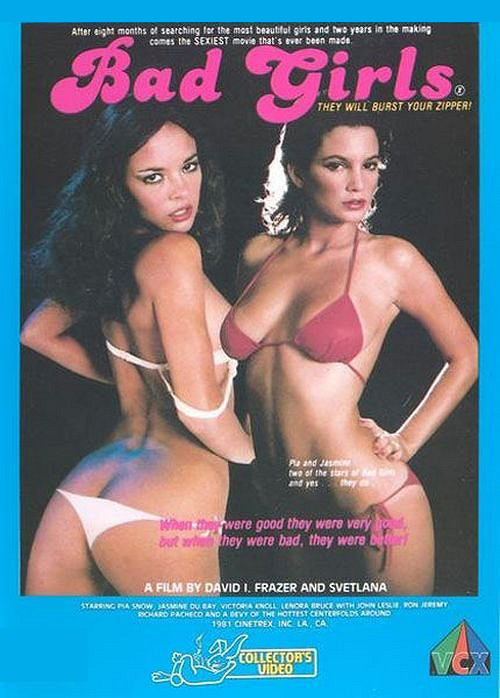
Where did you shoot ‘Bad Girls’?
We shot in a mansion in the Echo Park/Silverlake area of Los Angeles, and in the forests around the river Kern, southern Sierra Nevada mountains.
‘Bad Girls’ wound up being very successful…
Yes, it was. Once we had a finished product, Svetlana and I went around the country meeting with potential sales outlets everywhere. We flew to every major state, and Svetlana set up meetings with all the buyer and distributors. She told them the film was going to be on Penthouse and Playboy.
The film had a lot of publicity.
We bought covers in so many magazines. It was a major campaign, all to help us promote the film.
What did you make of Michelle Bauer (aka Pia Snow) who starred in the original ‘Bad Girls’?
She was really sweet. And she was talented – she could actually act! She went on to become a ‘scream queen’ in horror films. That may not be true Hollywood success, but she certainly had a successful career. I liked her.
Given that you were doing your own distribution, how did you make sure you knew what the grosses were?
Once ‘Bad Girls’ was out in theaters, we sent my brother-in-law to New York to count ticket sales! We didn’t trust the cinema owners to give us a fair accounting. We knew we had a hit on our hands, so we wanted to maximize our return on it.
After the theatrical release of ‘Bad Girls,’ we did a video release. We rented a space in North Hollywood and bought machines to duplicate the tapes so we could do that ourselves too. We started out with about a thousand square feet of space but after a month we expanded to two thousand feet to meet the demand – before long, we grew to ten thousand feet.
So you were doing rather well.
Collectors Video, our video release company, thrived – especially with our ‘Bad Girls’ title. For my 30th birthday Svetlana surprised me with a brand new Ferrari. She knew I’d always loved racing cars – I used to go to Brands Hatch racetrack in England and Ferraris were my dream cars. So suddenly I had one – that’s Svetlana for you! But to answer your question, yes we were doing well.
We also made enough to buy a beautiful new home. Eventually, we got a boat that we kept at the Marina del Ray. We had an accountant named Howard Hughes – which was a good start. Howard said to me, “David, if you play your cards right, you’ll be set for life.”
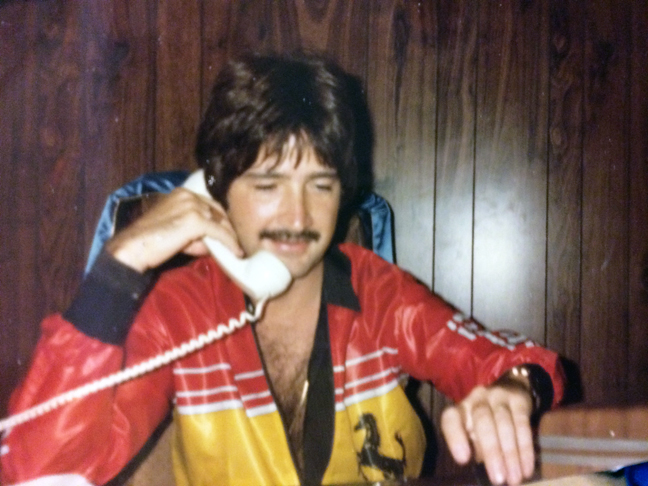
Did you decide immediately to do Bad Girls II?
As soon as we realized what a success the first film was, we knew we should do a sequel. So ‘Bad Girls II’ was definitely planned. But as for the films released under other Bad Girl titles after that, that was distribution companies re-naming some of our work to take advantage of the first film’s success.
We shot ‘Bad Girls II’ at a Saugus film production ranch near Los Angeles where a lot of people shot. It was like a whole town, a reasonably big town, that you could rent so we went and shot there. It was a three-week shoot which wasn’t common for adult films at the time – they were normally shot in a matter of days.
Later on we also wound up shooting a film we called ‘Nice Girls Do’ that ultimately came to be marketed under the title Bad Girls 4 to take advantage of the popularity of the franchise. We shot that one for both X and R and edited it as an R-rated feature.
I tried something similar years later when I made my movie ‘Stormswept’. I tried to make it both a horror film and a very sexy film. But it wound up not doing either terribly well. The movie just found itself in no man’s land.
Outside of the ‘Bad Girls’ films, did you do a lot of personal promotion for your other movies – interviews, attending premieres and things like that?
We did magazine promotions, nothing personal though, and used the performers to market the films. I shied away from putting my face out there and so did Svetlana. We didn’t do interviews. We had no interest in being public figures.
We did go to one of the award ceremonies once. I remember weaving through some reasonable sized crowds to get into the auditorium – and my first thought was, “Look, we’re famous!”
Then I saw these crowds were carrying signs with slogans like, “You’re Going to Hell!” They were all there to protest the event!
Actually, I once also got hit in the face by a buyer at a CES show. I went up to him and told him he owed us $30,000 and I’d come to collect. He’d bought a bunch of videos from us and the scumbag hadn’t ever paid. Well, he got me with a left hook from the side and I went down. Maybe I should have called the cops and filed a complaint, but I just went on.
There’s a photograph from the time of some girls sitting on my lap and I’ve got this big shiner. It’s funny in retrospect. But, in general we stayed away from these types of public events…
But if you weren’t doing publicity, you were pretty much doing everything else from soup to nuts…
Yes – from coming up with the idea to writing the script to shooting and editing… all the way to duplication and distribution. We hired the sound and editing teams ourselves and oversaw all their work too.
We had it down so well that we began servicing other clients, doing post-production on their films. We expanded our company to include a large sound studio, and that studio extended beyond the adult industry. Danny Elfman recorded at our studio. Carter Burwell, the famous Hollywood composer, also recorded there.
One day a sound designer who worked for us said to me, “David, I’ve worked for a lot of people but I’ve never met anybody who does everything. Everything! You do the studio work, you do the editing, you do it all.” I asked, “Well, isn’t it part and parcel of what a normal producer does?” And he said, “Definitely not!”
We named the company Digital Post. We hired about 12 or 13 people to start – sound recorders, sound mixers, that kind of thing. We bought all the sound equipment too.
How did you and Svetlana find time to make your own films?
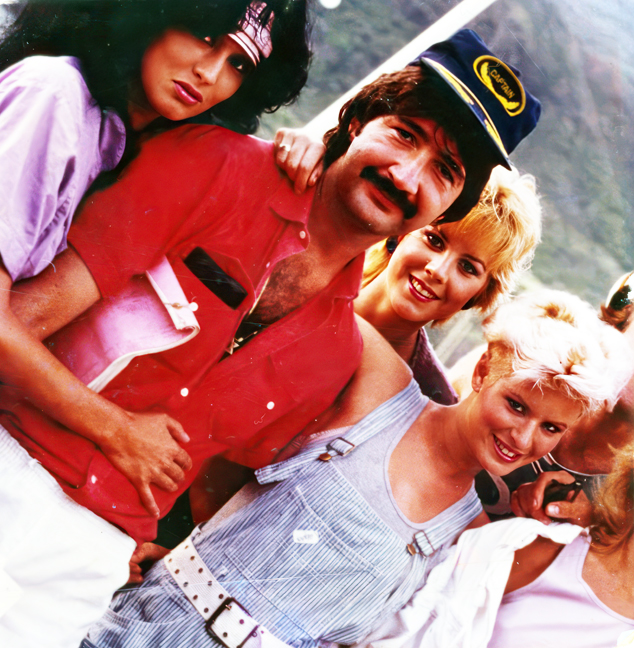
We were shooting about three films a year – we’d mostly do them individually except for the ones we’d shot in Hawaii – where we shot two at a time to ensure we got a return on the investment. We figured that if we were going to have the expense of flying an entire crew to Kauai, we needed to get two feature films out of it. That schedule left us time to do our own work and service other clients.
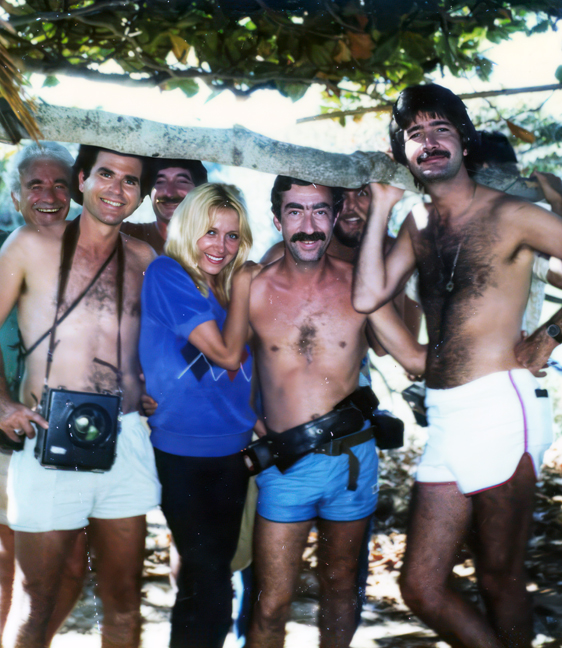 Svetlana and David and crew shooting in Hawaii
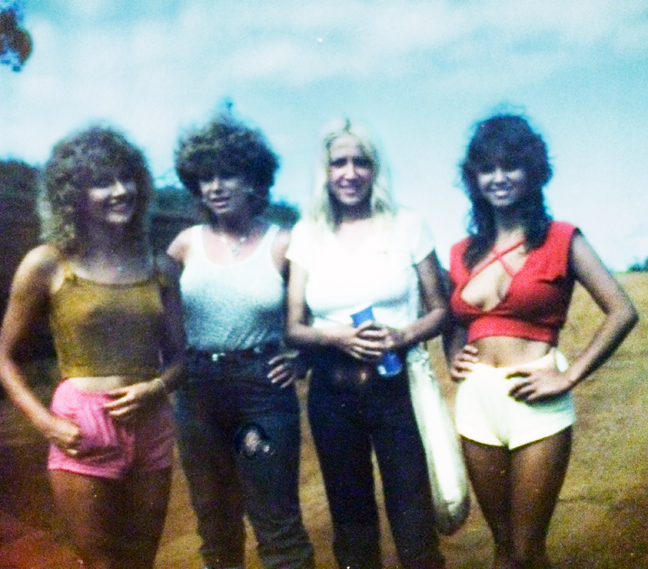
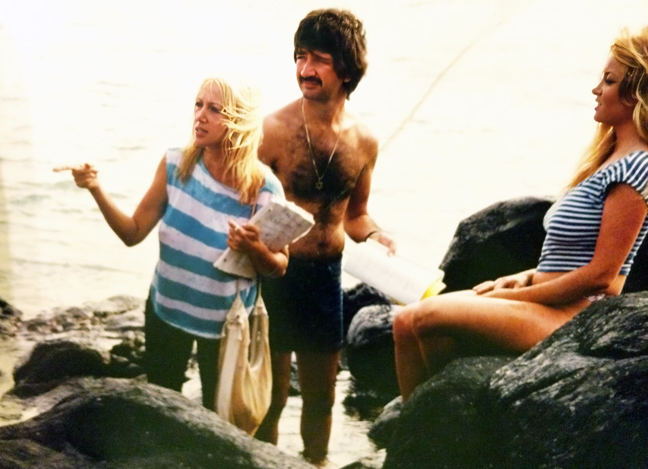
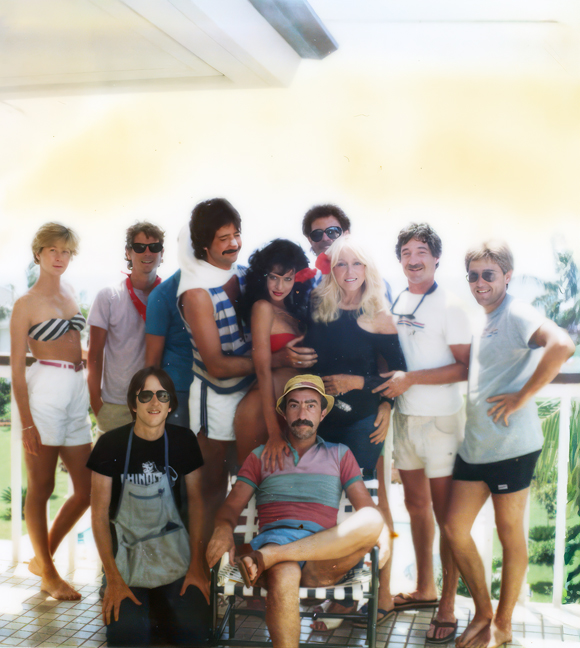
Let’s talk about the films shot in Hawaii. How did you and Svetlana decide to shoot there?
Svetlana’s style as a filmmaker was always very glossy, very big budget. She liked to shoot in exotic locations. We liked to get on an airplane and take the cast and crew someplace special.
Somebody mentioned that Kauai was stunning, so Svetlana went for a couple of days to do some scouting. When she got back to L.A., she told me how excited she was about it and that I had to go and have a look. So we went back together – and loved it.
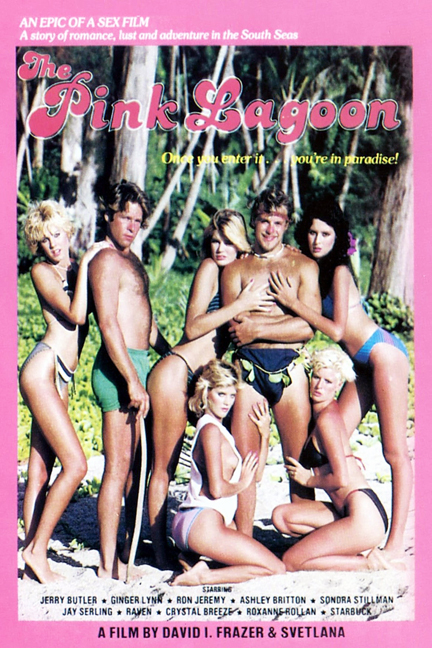
We wound up shooting A Little Bit of Hanky Panky and Surrender in Paradise there. We took the same approach when we filmed The Pink Lagoon and Panty Raid back in Hawaii.
How did it work shooting two films simultaneously?
When we shot two movies at once, we considered one the A feature and one the B feature. The B movies were definitely second tier for us, but they were still good. We did our best to come back with two quality films each time.
Do you remember Joel Holtzman, a photographer who shot for you on a couple of your Hawaiian films?
Yeah – he had the hots for Svetlana.
Ginger Lynn starred in your first films shot in Hawaii – how was it working with her?
I always loved Ginger – she was one of the few people that we would actually see afterwards when she was living in Century City.
Ginger totally got what I was trying to do on set to get to the passion that would lead to sex. Like the scene Ginger had in the hut on the beach with Jerry Butler. The sex feels powerful because it wasn’t just scenes in a script, and then… all of a sudden, the sex. It was all about the context – what happened to create the sex, which is what makes it ultimately arousing or not. It’s all about the reason why – and Ginger got that.
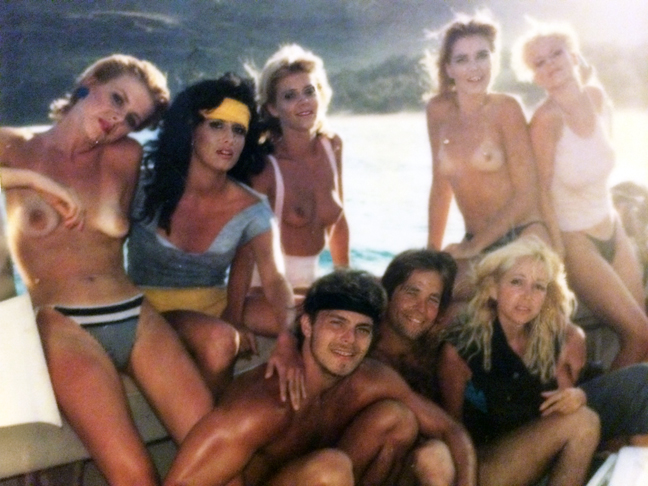 Ginger and cast in Hawaii
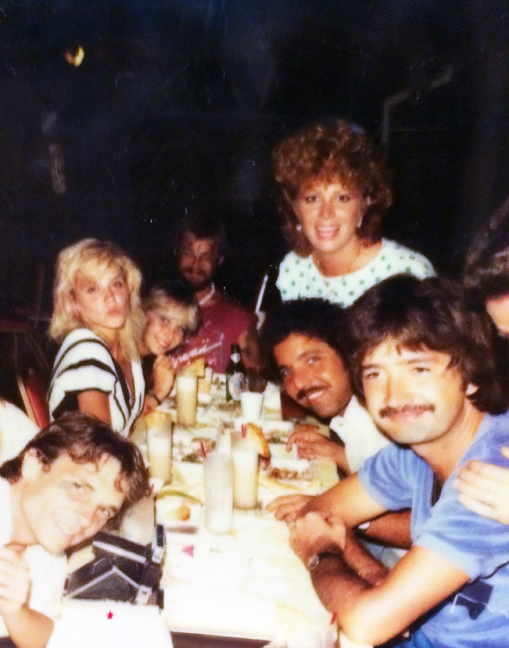
What about Ron Jeremy? He was also in ‘Pink Lagoon’ and ‘A Little Bit of Hanky Panky’…
I remember Ron begged me to let him be in those films. He also begged me to be in ‘Surrender in Paradise’ and ‘Bad Girls.’ None of the girls wanted him there, but he found his way into everything.
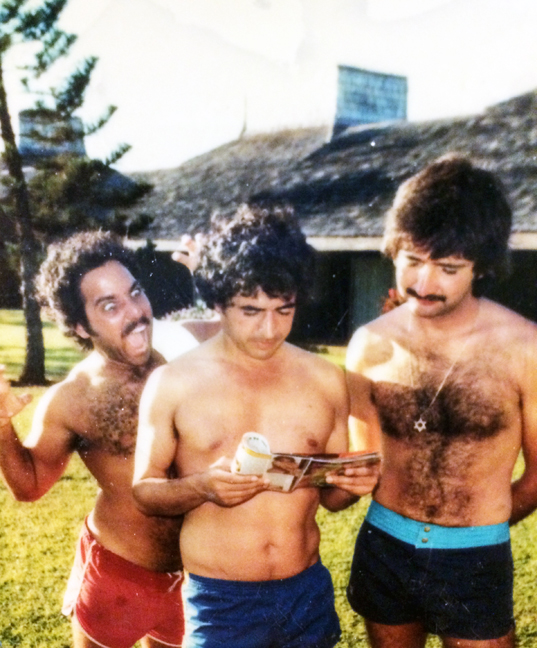 Ron Jeremy (left) with Jamie Gillis (middle) and David (right)
Were you aware that Ginger claims that Ron Jeremy raped her while filming in Hawaii?
She did? I had no idea. We were friends with Ginger and she never told us. That is really terrible to hear.
We did see Ron regularly do this thing with women where he’d start with a neck rub and push his luck from there. But no, I never heard anything about this and never saw anything on set.
How did you connect with talent?
We mostly used Jim South. To be honest, we weren’t so stuck on getting the best actors. What we focused on was the look of the films and the tease. We wanted gorgeous girls, gorgeous locations.
But that didn’t mean the performers we got were without talent. Ginger, for example, was quite talented.
Was there anyone else from those early films that stood out for you?
I became quite friendly with Jamie Gillis. And I liked John Leslie, though I didn’t get to know him nearly as well as Jamie. Both Jamie and John were proper actors and good on set, so we used them quite a bit.
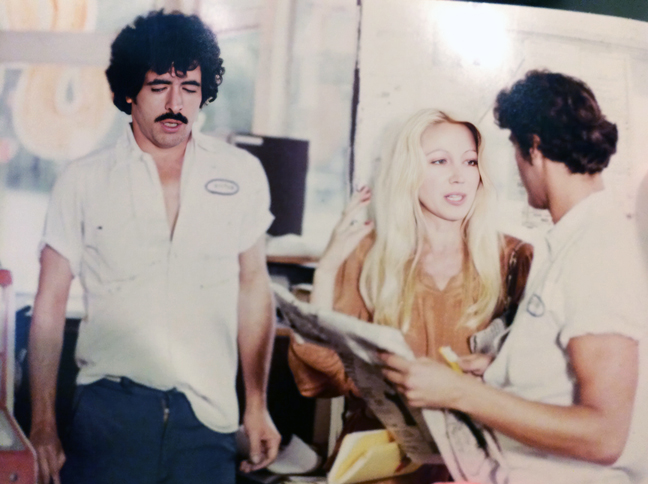 Jamie Gillis (left) with Svetlana (middle) and Bud Wise (right)
‘BB Black’ is listed as editor on a number of your films – was that you using a pseudonym?
No, that wasn’t me. It was actually a generic name I used for editors who came from Digital Post, the studio Svetlana and I had started. But they were all real editors who shared the name when they worked on our films.
After making several adult films, were you enjoying the work?
I loved it. I loved making our movies, I loved our studio. The money was nice too.
It was creative. I remember early on when we were in a house in Pasadena shooting ‘Ultra Flesh,’ the art director we hired hadn’t delivered on anything. I quickly came up with the idea to use dry ice. And it wound up looking great. Unfortunately, it also destroyed the floor of the location we rented which the insurance company didn’t pay for so we ended up having to cover thousands of dollars in damages. But being able to think on a dime and do creative things… Yeah, I loved it, no question about it.
Was there anything you didn’t love?
I would get tense sometimes before a shoot, mostly nervous that we might be busted by the police. You never knew, especially shooting in Los Angeles, if somebody would call the cops – because it was illegal. And that weighed on my shoulders enormously.
I remember one time, we were at Svetlana’s mum’s house in West Hollywood. Her mother came rushing into the kitchen and told us there was a cop in a car right outside. We were on the way to a location shoot on the other side of Hollywood, so we hid inside, waiting to see if the cops would leave. Eventually they did but it took a long time.
After that, we got a letter from someone claiming to be a cop, saying we were being watched, and he didn’t agree with it. He said they knew all about the films we were shooting, and he told us we should change our shooting plans. The letter was signed by Anonymous.
So yeah, I was freaked out at times during those days. But once we got rolling on set, I was all in.
Did you have any other sorts of trouble on the sets of any of the films?
Not so much. There was one actor who always had a problem getting it up – his name was Richard Pacheco. And I would get on him because he was costing us time which was costing us money… and then he’d start cursing, calling me names.
But that’s about the worst that ever happened. Most everybody just did their thing, and we did our thing. We tried never to go over a 12-hour day. We looked after people, had proper craft services, and we paid on time. We ran what I think of as good, professional sets.
Did expanding your studio and post-production work intensify your concerns about being busted?
Sometimes yes – especially if we heard that somebody had got raided. When that happened, we’d go into panic mode. We’d hide all the masters.
To be honest, I was never 100% comfortable. The question of legality was always in the back of my mind.
Our lawyers told us, “Don’t worry, they have no grounds to do this,” but that didn’t make any difference if you were in the back of a cop car, right?
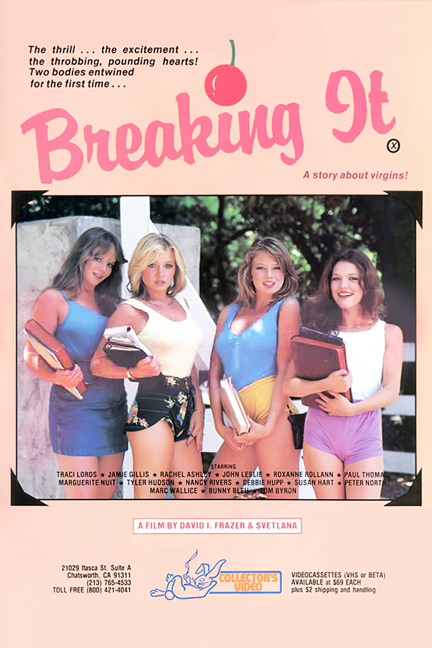
But the money was good, and the work itself could be creative, so we kept on doing it. Like our movie Breaking It – I really loved making that.
What was special about ‘Breaking It’?
By that point, we’d learned how to make a creative film really efficiently, getting what we wanted and spending less money for it, though we still worked with meaningful budgets to cover the cast, locations, and production value.
We made ‘Breaking It’ for about $40,000, really cheap – but it didn’t look that way. It looked expensive. It had an interesting storyline – an exaggerated schoolgirl-teasing-her-teacher kind of thing that I thought worked really well. And we shot some great scenes out in Hollywood. I set up a camera car for the film – I mean who does that for a porno?!
By the mid-1980s, the adult film industry had turned largely to video instead of film. How did that impact you and Svetlana?
It all turned really quickly: as film productions turned to video, the profits from any single film declined dramatically. Blockbuster introduced rentals and that changed everything. People like Russ Hampshire of VCA, all of a sudden, seemed to be making a film a week. Everybody started churning out films. Suddenly the market was swamped – and volume seemed to matter much more than quality.
When the industry shifted like that, I knew I didn’t want to be a part of it. The profit margin wasn’t there anymore to make the kinds of movies we wanted to make.
Did Svetlana feel the same way?
Svetlana still wanted to make movies. A friend of mine, somebody who used to work at Collector’s Video and had a very wealthy uncle, came to me and asked me to make two films for him. I said, “No thanks,” but Svetlana said she’d do it. Those were the ‘Miami Spice’ films. And Svetlana made those on her own. It put our relationship on a rocky road for a little bit.
Did the advent of VHS create financial issues for you?
It wasn’t the move to video that sank us financially – it was a couple of other reasons.
And the first was Traci Lords.
You and Svetlana made a number of films with Traci Lords…
We did. The first one was ‘Breaking It’ which we released in 1984. Of course, hardly anyone wound up seeing it because it was pulled off the market when the news came out that Traci wasn’t of legal age.
Did you have suspicions that Traci was underage?
None at all. I was totally shocked when I heard the news. If there had been rumors going around beforehand, I never heard them.
Jim South screened all the talent as part of the deal of working with him. And Jim was very methodical about checking IDs and keeping copies of them in his files.
What was Traci like on set?
Professional. I liked her. I know some of the other girls didn’t care for her, but she was always fine with me and Svetlana. I mean she was somewhat manipulative by nature – like she’d push her body up against me at times, that kind of thing. But I didn’t fool around so I just brushed her off.
 Traci Lords
Who didn’t like Traci?
Ginger for one. Ginger called Traci “the little cunt.”
Some people, including Traci, said she was using a lot of drugs during that time. Did you ever see or suspect any drug use on her part?
Well, I didn’t do drugs and so perhaps I’m not the best at spotting other people doing drugs. All I can say is she seemed very compos mentis to me. She was sharp, especially when it came to her fee. She definitely seemed money-oriented – and she wanted to be paid on each day that she worked, rather than at the end of a project.
She always seemed smart and in full charge of all her faculties whenever I dealt with her.
So what happened in your and Svetlana’s world when the news broke that Traci was underage?
The timing couldn’t have been worse for us. Svetlana and I had seen that the industry was changing, so we had just sold all of Cinetrex and our catalog of adult movies to Gourmet Video, with our sale fee coming to us over 2 years. Shortly after we inked the deal, the Traci news broke and Gourmet said, “You sold us titles we can no longer use, so we’re gonna stop paying, until we iron out a new agreement. If you wanna sue us, go right ahead.” They knew we couldn’t go to court over Traci Lords movies. So Svetlana and I settled with them. Traci Lords cost us $300,000 in real money. That’s what Traci Lords did for us.
Of course, anything we had left from those films we disposed of as soon as word of the scandal hit the wires. We got rid of anything that could in any way be confused with materials from those movies.
It was a tough time.
You said it wasn’t just the Traci scandal that impacted you financially.
You know how when there’s a plane crash, it’s not normally one thing, it’s multiple things? Well, that’s what happened with our financial downfall.
Right before the Traci news broke, Svetlana and I bought a huge estate in the Hollywood Hills with the down payment we got from the Gourmet Video deal. It was Errol Flynn’s old estate – a really, really nice place. But now we were carrying a sizable mortgage because we didn’t receive $300,000 of the Gourmet money.
On top of that the NABET union [National Association of Broadcast Employees and Technicians] went on strike. That happened in 1987 and that killed our Digital Post business.
How so?
NBC was our biggest client at Digital Post at that time. We did most of the on-air promos for their new shows coming out. As soon as NABET went out, NBC stopped production – dead.
At first, we didn’t know how long the strike would last and were hoping we could ride it out. To buy ourselves time, I figured I would re-finance our new house so we could take some cash out of the loan and be able to stay afloat. But when we went to re-finance, we discovered that a past owner of the property had taken land that belonged to the city of Los Angeles and claimed it as part of the estate. When they did all the new surveys required as part of our refinance request, those surveys revealed that a lot of what we thought was our property actually belonged to the city. We sued the title company, but that lawsuit went on a slow track and we didn’t have the time, or the cashflow, to wait.
So here we were. We couldn’t refinance to get money to live on and we couldn’t even sell the house because all of a sudden it was worth so much less than what we paid for it.
The bottom line is we lost the house and we lost Digital Post. So, ultimately, it wasn’t just $300,000 we lost from Traci, it was like millions. And we were never able to get back to where we were.
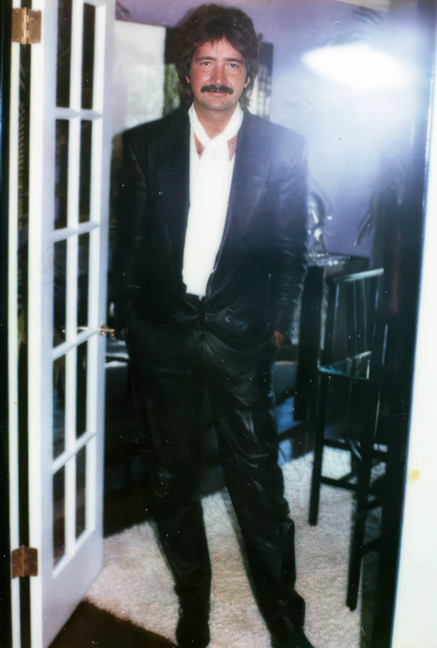
*
5. Life After Porn
Did you and Svetlana move to Hawaii when you ran into the financial trouble?
It was around that time. It was really because I was completely miserable in Los Angeles by that point. Svetlana – who took the lead in most things when it came to us, I’m not embarrassed to say – suggested I go to Kauai and look for places to live. She had a soft spot for Kauai and felt connected to Hawaii in a spiritual sense.
I found a property there and wound up moving first without Svetlana because she had to tie things up in Los Angeles. We lived separately for a year and a half, but our relationship was strong so we could handle it.
You mentioned that Svetlana felt connected to Hawaii spiritually – was she spiritual?
Immensely so. Nothing religious or from scriptures, just her own style of connection. There was a very active new age Metaphysical movement back then that Svetlana was interested in. And she was writing a book, working title ‘If You Were God’, for 25 years. It was about realizing you are God and therefore you can create miracles with the power of belief.
She didn’t always practice what she preached, but she was always visiting New Age bookstores. She never got her work on the topic published, but she was much more involved in spirituality than the X-rated films she made. She was searching for a higher meaning in life.
So when she finally arrived to live in Kauai, did that further deepen her spirituality?
Actually, when she arrived in Hawaii she began to go to fewer of the spiritual conventions and bookstores. I think it was because as she aged, her Asperger’s framed her life more and more.
Svetlana was self-aware enough to know she had fixations she couldn’t let go of and an awkwardness she had difficulty tempering.
Hawaii wasn’t the center of the film industry – what were you thinking would happen career-wise when you moved?
I was still thinking of doing film and video but you’re right – Hawaii is definitely out of the mainstream. Honolulu had a bit of film production, and once in a while a movie gets commissioned locally. But most of the work shot in Hawaii comes from the mainland – like Svetlana and I had done when we were looking for exotic locations.
But you did make a few movies after the adult films…
I did. In the late 1980s I worked as an editor on The Freeway Maniac (1989), a horror slasher film, and I directed the fantasy film The Lords of Magick (1989) which told the story of brothers from 10th century England who show up in modern day California.
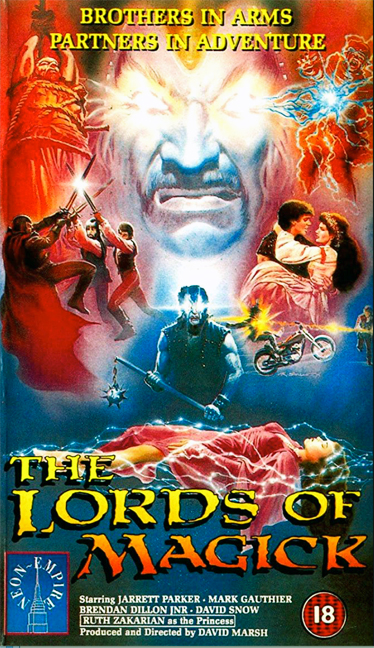
What do you remember about making ‘The Lords of Magick’?
It starred Jarrett Parker who is now quite a well-known magician in Las Vegas. Jarrett and I had been interested in wizard and warlock things way before Harry Potter.
But the problem was that it was just too low a budget for such a big idea. I bought a professional beta camera for about $35,000 thinking that would be the most economical way to shoot the film. But I should have actually learned how to use the camera – instead I hired this guy, Bruce Birdside, and he was just a terrible DP.
Ultimately, the film wound up costing much more than I’d budgeted. I was able to sell it around the world, and I sold it for TV production here in the States. A little later a company picked up video rights. But I was going through so much financial trouble at the time that I didn’t even track the sales properly.
So that’s another film that went on to make money that I didn’t receive anything for.
Outside of the film work you were hoping to pick up, you also published a promising novel around this time titled ‘Into the Abyss’…
‘Into the Abyss’ came to me as a dream when I was 13 or 14. In the dream, I discovered a portal at the bottom of a swimming pool leading to a world where all the people were dying because there was a lack of salt. I had to save these people by bringing barrels and barrels of salt through the swimming pool – which was a dilemma – and get it to them so they would survive.
It was Svetlana who said, “You have to write it!” So I did and I got an agent for a while, but he couldn’t get anything off the ground. Eventually the book did get optioned, and Svetlana and I were jumping up and down on cloud nine thinking we had a hit movie on our hands. But ultimately it didn’t go anywhere. ‘Into the Abyss’ just didn’t do it.
How open were you about the adult films you made once you left the industry and moved to Hawaii?
I’m basically going to say I lived my life as something of a lie after I left the industry. I wouldn’t talk about the adult films I made, and Svetlana didn’t either. We kept completely silent about them.
Did you and Svetlana have an explicit conversation about not sharing your adult film past?
Yes. Though in later years Svetlana did waffle a bit about it. She was writing her memoirs and was going to put it all in the book. But she’d go back and forth – she’d think she was going to do it and then she’d make a 180-degree turn. But ultimately, I think she knew her book wouldn’t be truthful if she didn’t include that part of her life. And if the book is a lie, you’re not saying who you really are.
And anyway, the adult films weren’t her and they weren’t me. It was just a short period of our lives, but it wasn’t who we really were or are.
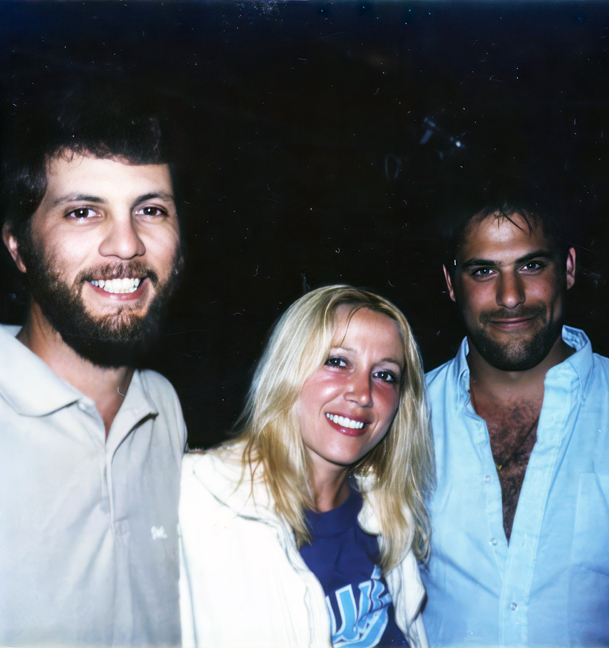
How difficult was it keeping it all secret?
Svetlana and I just got into the rhythm of not telling people the truth – not saying anything about it when we met somebody new. Yes, I worked in the film business, and I wrote and did some TV stuff, but I never, ever would’ve dreamt of telling people about the 17 or 18 adult films I made.
Did you or Svetlana ever wish you hadn’t made the adult films?
Svetlana and I never discussed that so I don’t know what she’d say. But part of me wishes I never had, absolutely. It meant that I never gave myself the opportunity for mainstream success. I was definitely talented – Jeremy Isaacs who produced the ‘World at War’ thought I was his prodigy and he went on to win all those awards. But because I made X films, which were a shortcut, I was held back. I was gung-ho when I did them but, after the fact, realized they constrained me.
Later after I left the industry, I was up to direct a film for Trimark. The thing is I didn’t share my full filmmaking experience because so much of it was related to adult film productions. This meant that on paper, it didn’t look like I had as much of a film background. And sure enough, I lost out on the opportunity because it was perceived that I had little experience in making a film – even though I had all this experience.
I remember one night right before Svetlana and I left LA for Hawaii, we were having dinner at Dan Tana’s and Alan Pakula was at the next table over. We started talking and were getting on well, until Ron Jeremy came in and charged up to our table, loud and recognizable as ever. He threw his arms around Svetlana and gave me a big slap on the back. I saw Alan roll his eyes and my heart sank.
But you can’t relive your life, so I’m not totally down on it. There were definitely times I think I made mistakes, but life throws curves that you have no control of. So even if I had just stuck to mainstream film production, I can’t say I would have been Steven Spielberg.
What are you doing now?
I still have to work – I’m an active photographer, and I’m comfortable. I’m finishing writing another novel. I’d like to find a publisher for it but if I can’t, I’ll self-publish. I have a few unpublished novels actually and I’m excited about them.
Why have you decided to talk about your past in adult films now?
I know you have been trying to contact Svetlana and I for years. We didn’t reply for a long time because we felt if word got out, it would limit our professional opportunities and maybe even our social interactions.
Then Svetlana died a year and a half ago. And since she’s been gone, I just started to feel like I didn’t care about keeping it a secret anymore.
Maybe in a sort of spiritual sense, what happened in my life is exactly what was meant to happen. You can focus on what you could have had or what could have been. I say to myself all the time that I’ve been blessed. When I look at the world and see the strife and struggle – I really have been lucky.
Svetlana was the love of my life, and she and I were really happy together.
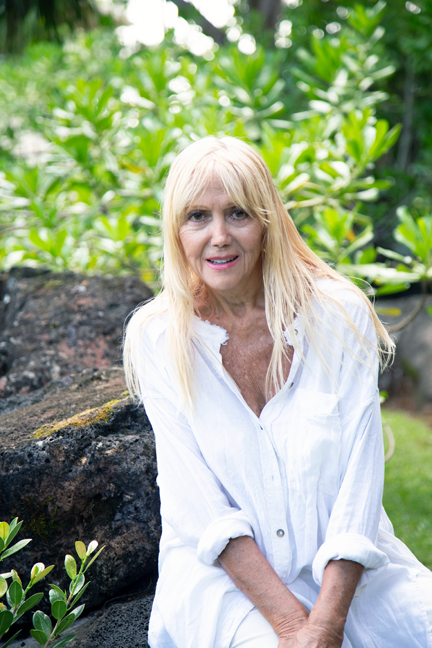 Svetlana
And how do you feel now that your story is going out into the world?
You know I’ve never given myself a chance to revisit the old days because we were living something of a lie – or at least we lived in a shielded bubble. Talking about this now, it’s nice not to have to wear the shield anymore. The adult work is just one of the many pieces of who I am. And it brought me together with Svetlana, and for that I’m forever grateful.
Svetlana always told me that there’s no decision I made in my life – that none of us make decisions. Everything that happens is destiny. She believed that we lived multiple times together. True or not, I don’t know, but she certainly taught me to open my eyes to the spiritual side of things. I definitely believe in reincarnation. Maybe not the way Svetlana did, but I believe energy isn’t created or destroyed. I believe something happens to our atoms after we die.
I’m more science-minded, but I do love the idea that the energy of those we loved doesn’t disappear. I absolutely believe Svetlana’s energy is still with us.
Do you think Svetlana would be happy that you stepped out from behind the shield and shared your story?
I think our conversation would have been interesting to her. She might have been a little strident – she’d probably be like, “What do these perverts want?”
But who knows. Hopefully I’ll meet Svetlana again in the next life and find out.
*
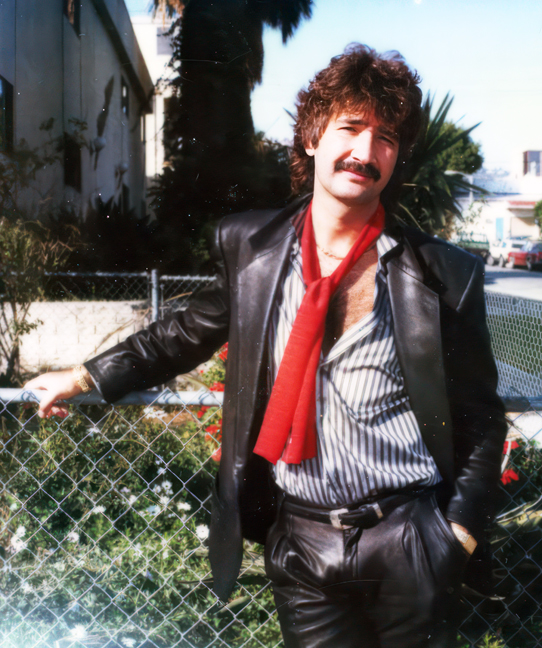
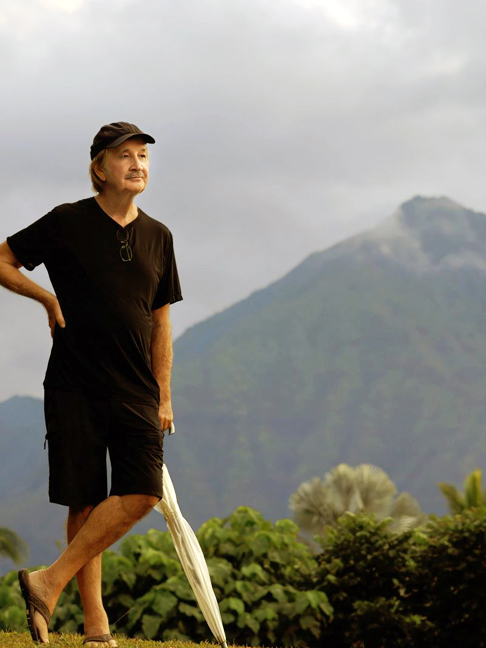 David today

Awesome Article Keep Up Good Work
Thanks Jeff!
Exceptional! The Rialto Report does it again (and again and again!)
I have long been a fan of David’s films (yes, even The Lords of Magick!) and so reading about his life is a treat.
Thanks Dave for sharing. I wish you all the best. You have quite a legacy.
Appreciate it Bill!
David’s love for Svetlana really comes across strongly in this history. It sounds like a strong and beautiful relationship against the backdrop of one of the most exciting times in the adult film biz.
I hope David manages to publish his books and that there is another act in his life!
I was a lowly crew member on Ultra Flesh and have very happy memories of working with Svet and David.
They were real film makers who just happened to be working in XXX and I learned a lot from them.
Good people too.
Great piece. I can attest that David and Svet spent a lot promoting their films because I remember seeing full-page ads for most of them in nearly every issue of Hustler magazine at the time. These were ‘borrowed’ from my father’s collection, so I was too young at the time to see them. But, they really stood out with the beautiful women and set locations.
Thank you David and TRR for letting us in on this piece of adult film history.
Thanks Todd!
Wow, the last three podcasts have been some of your best. I’m glad that David agreed to be interviewed, and I wish him the best of luck. Personally, I would pay a lot to see Ginger Lynn vs Traci Lords in the ultimate grudge matchup. It’s been long overdue. Cmon fight promoters! We want to see venom.
Thank you DS!
Awesome interview. Their films still hold up.
That picture with Jamie Gillis on the left (wearing the gas station attendant shirt) and Svetlana in the middle, is from 800 Fantasy Lane, so that’s actually Bud Wise (with his back to the camera) on the right, not Jerry Butler.
The gas station was on Sunset Blvd, early morning, the day I first met Svetlana, on location, 800 FL. I went onto marry her less than a year later. And Jamie became a friend. You’re right, Vincent, not Jerry Butler on the right. Mahalo.
Thanks Vincent – updated!
Another really poignant and revealing tale from the golden age. I don’t know how you keep up such a regular schedule of stories – all of the highest quality – but I am always fearful of the day that it will end!
Don’t stop!
AND thanks to David for a life well-lived!
Thanks so much Wayne!
Great films – great interview.
Thanks Tom!
This is awesome. I was always afraid that Svetlana and David’s story would be one of those that would get lost to the ether and never get told. So sorry to hear that Svetlana has passed but happy that David was willing to share so much about both of their lives and their short, fascinating time in the industry.
Brilliant interview about a fascinating and enigmatic couple – I had given up ever knowing anything about them…. and their story was well worth the wait.
Thank you James!
And another victim of Traci Lords… Yet the media still cling to the narrative that SHE was the only wronged party.
What a life. It seemed mostly criminals ran the distribution companies back then and the people who made the movies got cheated.
I didn’t know who Jerry Butler was until I saw him on Geraldo with his wife Wednesday. She met him while doing make up for an adult film. She married him. She expected him to quit porn and make money some other way.
That episode of Geraldo was very entertaining.
Fascinating story from start to finish! Great job!